Nobody books an island trip for ocean whitefish. They come up while you are fishing for something else: a long, tan, yellow-finned fish on the rockfish rig, or on the squid strip you dropped for sheephead. And then, more often than you would expect, they are the fish people are happiest to take home.
Ocean whitefish are worth knowing better than that. They are not from here, exactly. They are a southern fish at the top of their range, their numbers in the Bight rise and fall with the warm years, and they keep a daily routine that tells you where to drop. The ocean whitefish species guide has the short version. This post covers how the fish lives on the island reefs and what that means for fishing them.
A tilefish, not a whitefish
The name is misleading. The ocean whitefish is a tilefish, in the same family as the tilefish of the Atlantic and Gulf. Many tilefish dig burrows in the bottom and reinforce them with shell. The ocean whitefish is one of the exceptions: it does not burrow, and lives in loose groups instead.
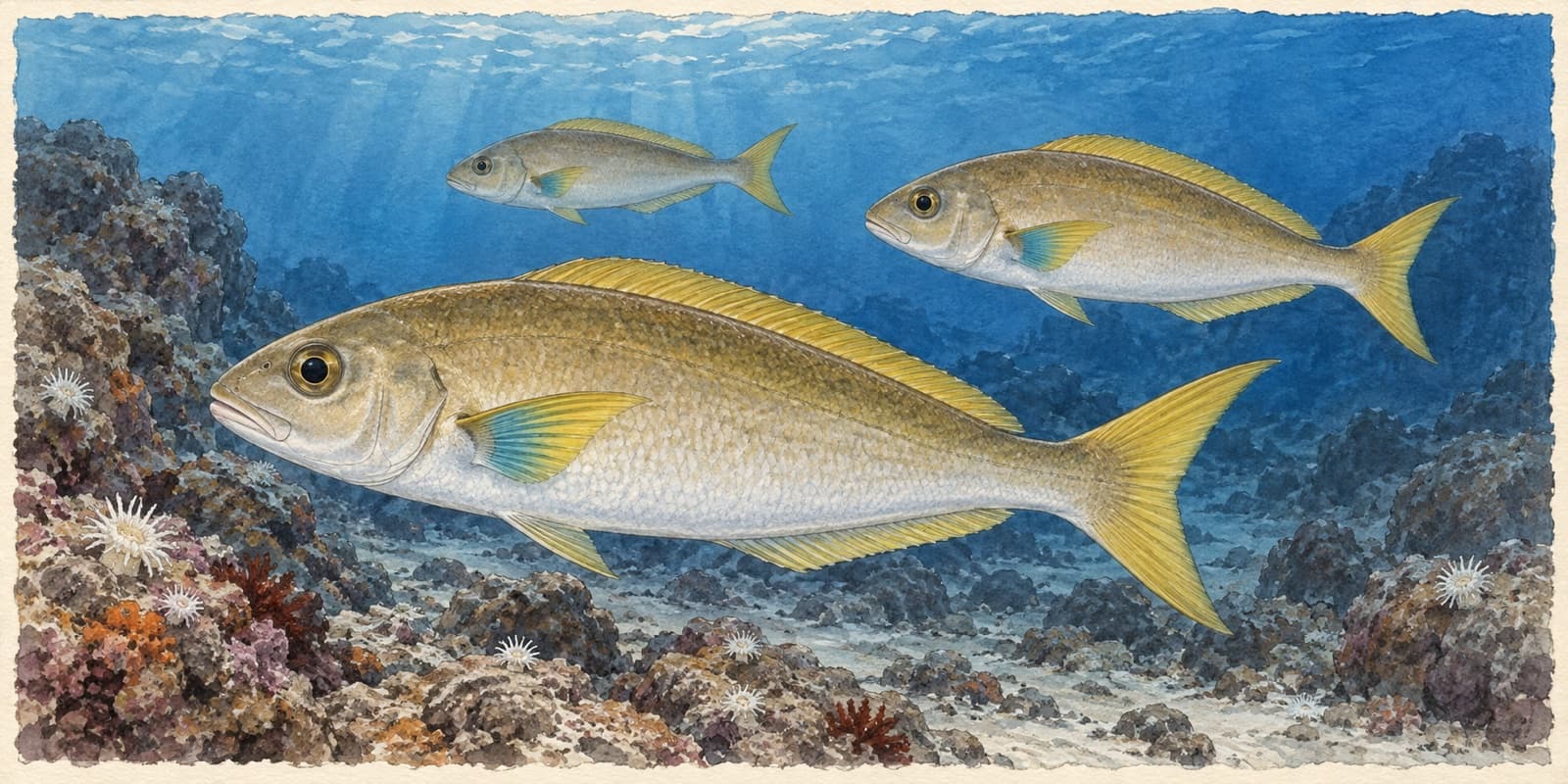
How to recognise one:
- Shape. A long, tapered body with a blunt, steep head and a big eye.
- Fins. One continuous dorsal fin running from just behind the head almost to the tail, and a long anal fin under it. No notch, no spiny front section like a rockfish.
- Colour. Brown-yellow to tan above and white on the belly, with yellowish fins and a blue streak in the pectoral and anal fins.
That blue and yellow fades fast once the fish is out of the water. A whitefish that looked bright at the rail can look plain brown in the sack an hour later.
Most whitefish caught in Southern California run 2 to 4 pounds. The species can reach about 40 inches, and it is thought to live about 13 years.
A fish from the south
Ocean whitefish range from British Columbia to Peru, but they are rare north of Monterey. Southern California is the northern edge of where they are common. They are far more common in Baja California, where a CDFW species report notes they rank among the most important fish in the northern Baja artisanal fishery and were the most plentiful species in the Ensenada fish market.
The Bight's whitefish may not even be born here. No ocean whitefish larvae have been found in Southern California waters, and the report suggests the local population is recruited from central and southern Baja. It is not known whether whitefish spawn in California at all.
Warm years bring whitefish
That southern connection shows up clearly in the catch. Party boat records show ocean whitefish in the Southern California catch as far back as 1936, and the numbers in their logbooks rise and fall with the ocean.
CDFW's report found that catches per angler on the party boats peaked after the El Niño events of 1982-83, 1987-88 and 1991-92, and rose sharply again after the 1997-98 and 2015-16 El Niños. In 2015 to 2017 the catch was dominated by small fish of 8 to 12 inches, which the report reads as juveniles moving up from Mexico on the warm water.
That is a pattern, not a promise. It is one more reason the warm years in Southern California change more than the tuna fishing.
Where they hold on the island reefs
Ocean whitefish are an island and bank fish. They are most common around the offshore islands, and CDFW's catch data put the bulk of the California catch in Southern California, especially around the Channel Islands. The usual addresses:
- Catalina. A short run from San Pedro and Long Beach. Our post on fishing out of San Pedro covers the island trips.
- San Clemente Island. Farther out, with plenty of hard bottom. Whitefish ear bones turn up in the island's ancient kitchen middens, a sign that Native peoples ate them there long before anyone fished from a sportboat.
- The northern Channel Islands. Whitefish are common in island bags at Santa Cruz Island. See fishing out of Channel Islands Harbor.
- The Coronados. Good whitefish water off Point Loma, but Mexican waters with Mexican rules and a Mexican fishing licence.
A tracking study of adult whitefish found that they keep a daily routine. By day they range over the deep sand next to the reef, and at night they move into shallower, high-relief rock or kelp. The tracked fish spent their time between about 60 and 220 feet and showed strong loyalty to their home area. They feed by day and do little feeding at night.
For an angler that points to daytime drops on the edge where the reef meets sand and rubble, rather than deep in the rock where the rockfish sit. It also explains why whitefish show up on the same drops as rockfish but a little off the rock.
How to fish for them
Whitefish eat crabs, shrimp, krill, small octopus, squid and small fish, much of it picked off the bottom. They are not hard to hook if your bait is where they are.
- A dropper loop rig. The standard rockfish rig works. Our guide to rockfish rigs, dropper loops and shrimp flies covers how to tie it and what sinker to use.
- Squid strips. The most common whitefish bait. Cut bait and shrimp work too.
- A few feet off the bottom. Hold the bait just above the bottom rather than lying on it, especially over sand next to the rock.
- Modest hooks. Whitefish have small mouths for their size. A hook sized for squid strips and rockfish is about right.
This is a boat fish. CDFW's survey data show most of the whitefish catch comes off party and charter boats, with private boats making up most of the rest and shore anglers barely registering.
Handling and the table
Ocean whitefish do not have venomous spines, but the edge of the gill cover is serrated and sharp, so grip the fish behind the head rather than across it. The spiny, venomous fish that comes up on the same island drops is the California scorpionfish, and our post on sculpin, spines and season covers how to handle it.
The meat is mild, with a soft texture and small flakes. Many people skin the fillets, as the skin has a strong taste.
The neighbours
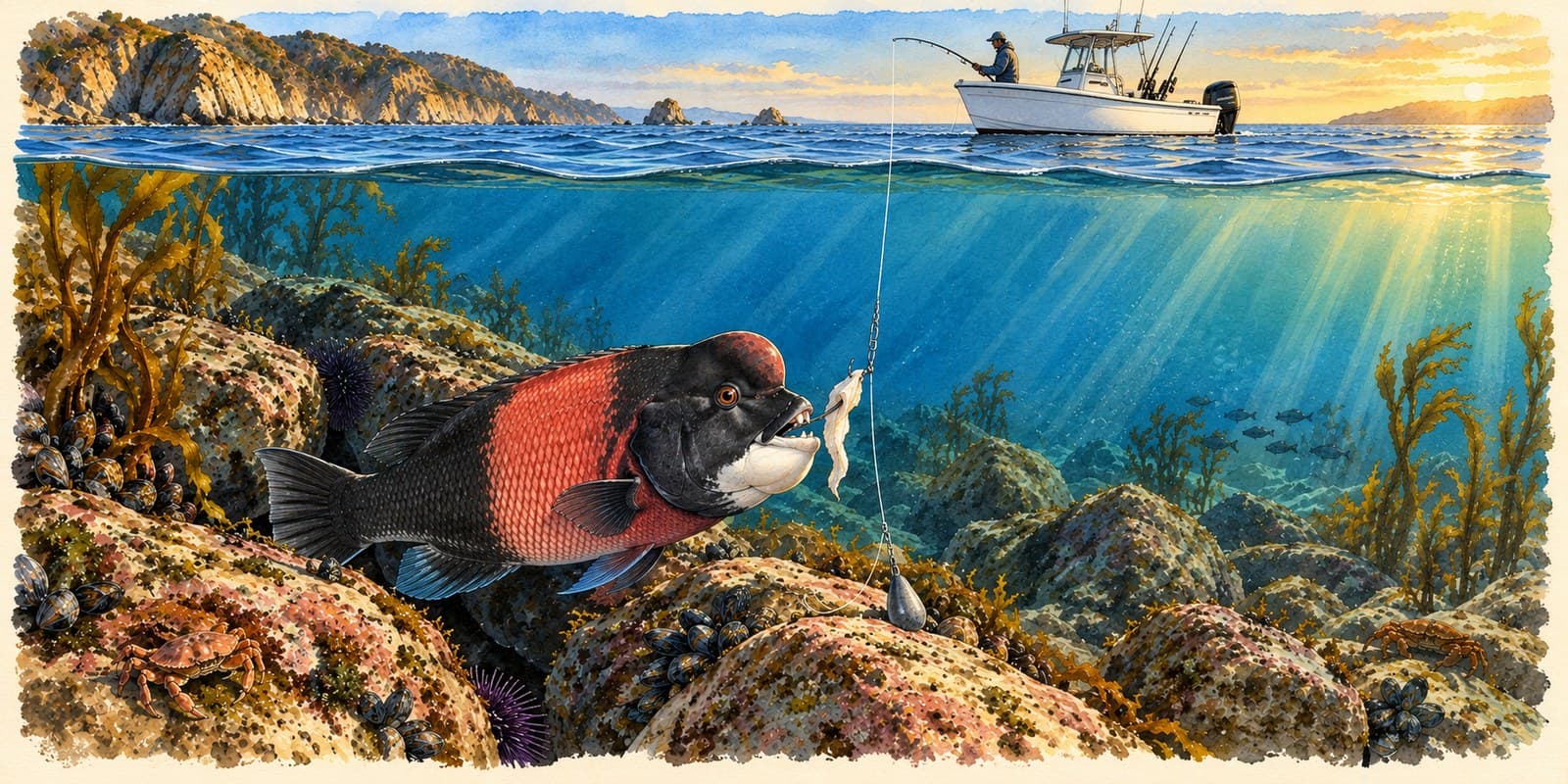
Whitefish share the island reefs with the red-and-black wrasse that crunches urchins and changes sex, and fishermen on those reefs often catch the two on the same trip. Our post on California sheephead on the reef covers that fish. Bigger things eat whitefish too, including sharks and the protected giant sea bass.
Rules
Ocean whitefish are state-managed, and since 2023 their season has been set separately from the groundfish rules. Check the current CDFW Southern Region regulations for the season and bag limit, and remember that a boat fishing for rockfish at the same time needs a descending device aboard.
Where Fish or Pass fits
The whitefish guide is a profile. Fish or Pass does not grade ocean whitefish. The Bite Score reads conditions for rockfish, the fish whitefish share their drops with, as Catching, Fishing or Pass. A calm day on the island reef helps both. The score cannot tell you whether this is a whitefish year, and it cannot make one bite.