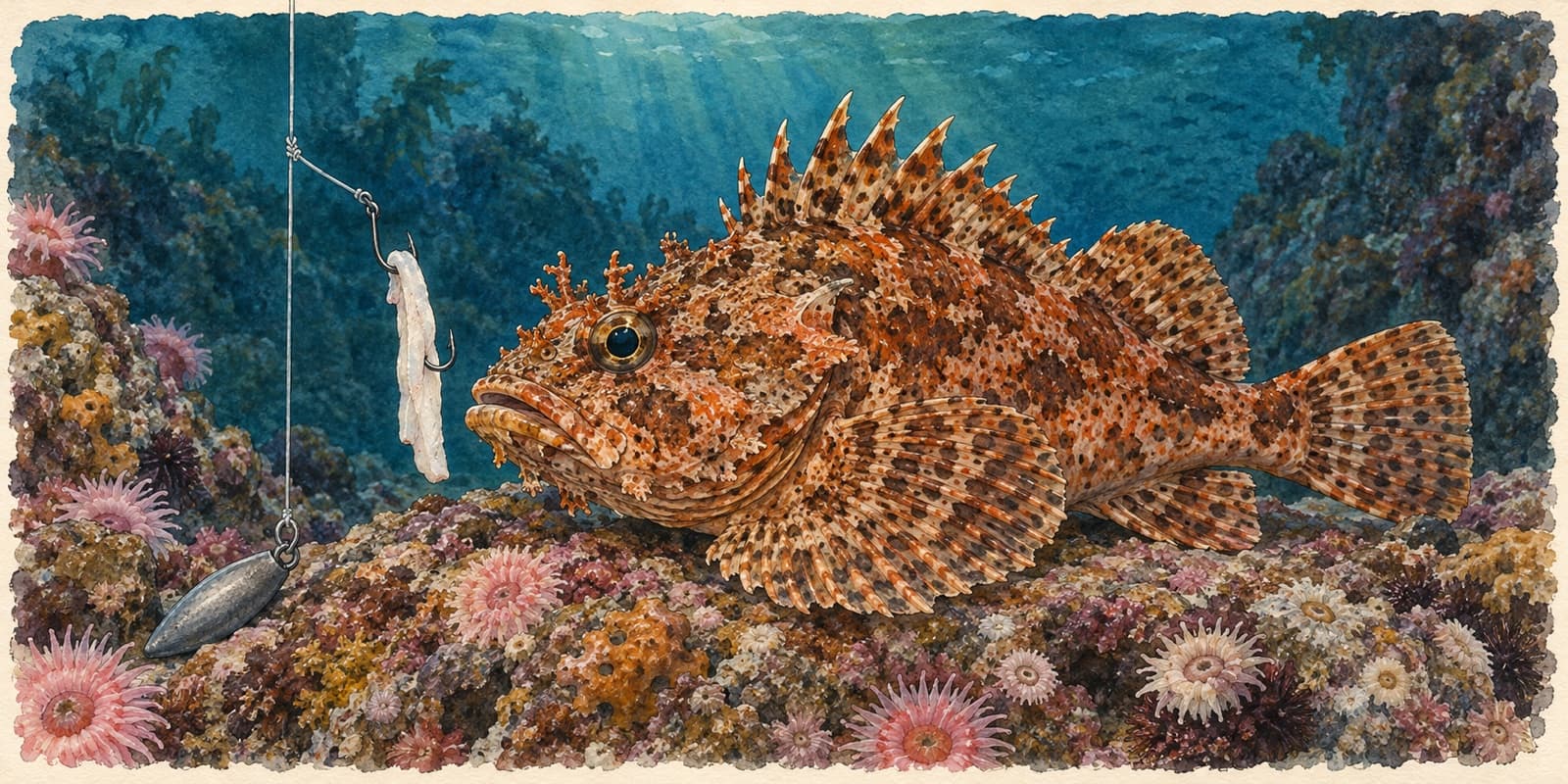
Sculpin are easy to catch and hard to hold. The fish sits on the rock, eats a squid strip without much fuss, and comes up flaring a set of venomous spines that will ruin your afternoon if one goes into your hand. Most of what separates a good sculpin trip from a bad one happens after the hookset.
This guide covers the rig and bait, how to handle and unhook a sculpin, what to do about a sting, and how the year runs for this fish. For the fish itself, start with the sculpin species guide.
What you are catching
In Southern California everyone calls it sculpin. The book name is California scorpionfish, Scorpaena guttata, and it is a true scorpionfish, not one of the true sculpins, the family that includes the cabezon and many small tide pool fish. It is managed as one of the groundfish, alongside the rockfish, and it turns up on the same rock, wrecks, artificial reefs and hard bottom.
The venom sits in the spines of the dorsal fin along the back, the anal fin underneath and the pelvic fins on the belly. When a sculpin comes out of the water it flares all of them.
The rig
Sculpin tackle is rockfish tackle. If you already fish the gear in our rockfish rigs guide, you are most of the way there.
- Rod and reel. A medium to heavy conventional rod with a reel spooled with braid. Braid has almost no stretch, so you feel the bites and the sinker on the rock.
- Top shot. A short length of 25 to 30 pound fluorocarbon between the braid and the rig takes the abrasion from the rock.
- The rig. A double dropper loop with a torpedo sinker on the bottom, roughly 4 to 8 ounces depending on depth and current. Tie the bottom dropper long enough that its bait lies on the bottom. Sculpin are bottom fish and seldom come up for a bait.
- Leadhead option. A common party boat setup puts a half to one ounce leadhead with a small plastic on each dropper, and pins a strip of squid to the hook under the plastic. The color of the plastic varies by boat and day. Pink, red, orange, chartreuse and white are all common.
- Bigger fish. A single dropper loop with a bigger bait, a whole squid or a slab of mackerel, tends to pick out the larger fish.
California limits the number of hooks you can fish for groundfish. Check the CDFW groundfish regulations summary before you tie more droppers into a rig.
Bait
Sculpin are not picky. Frozen squid strips are the standard, and a fresh strip catches better than a washed-out one, so change it. Squid heads, cut sardine or anchovy, a slab of mackerel, a whole squid and live bait all work at times. Octopus is a favorite food and good bait when you can get it. If the crew is handing out something different on a given day, use it.
Where and how deep
Sculpin live from the shallows to several hundred feet. Rocky reefs in 50 to 70 feet hold plenty of them, but shallow reef is also where the small ones grow up. Party boats generally fish deeper, often 120 to 250 feet, where the fish tend to run larger. A two pound sculpin is a good one.
When the boat is anchored on a spot, the fish are on the structure under it. As the boat swings, anglers up the side, from mid-cabin to the bow, often stay over the rock longest. Watch where people are getting bit and follow the crew's call.
Handling the spines
Treat every sculpin as loaded, including the ones in the sack.
- Let the crew do it. On a party boat, a deckhand will unhook and sack your fish. That is the best option and nobody will think less of you for taking it.
- If you unhook it yourself, grip the fish by the lower lip between thumb and forefinger, with its body held out at right angles to your hand so the spines point away. Unhook with the other hand, using pliers for reach and leverage if the hook is deep.
- Never grab a sculpin around the body, and never pin one against the deck with your hand or foot.
- Watch the sacks. Spines poke through gunny sacks. Be careful around the bait tank where bagged fish often sit, and when you carry your catch off the boat.
- Fin trimming helps, but is not foolproof. Some deckhands clip the spiny fins with shears. Handle a trimmed fish the same way as one that has not been trimmed.
At the cleaning table, cut the spiny fins off before you start filleting, and keep your hand out of their path while you work. Once the spines are off, a sculpin fillets like any other fish, and the white, mild meat is the reason people put up with the rest.
If you get stung
A sculpin sting hurts badly and can last for hours. The standard first aid is heat.
- Soak the wound in hot water right away, as hot as the person can stand without scalding. Test the water with an unhurt hand first, because the pain can mask a burn. Clinical guidance gives a soak of 30 to 90 minutes in water around 104 to 113°F (40 to 45°C), topped up as it cools.
- Clean the wound and remove any spine fragments you can see.
- Get medical help for spreading swelling, nausea, dizziness, trouble breathing, a racing heart or fainting, or if the wound shows signs of infection later.
The traditional explanation is that heat breaks down the venom. A 2024 medical review notes the benefit may come at least partly from heat dulling the pain signal, and that good trials are lacking. Either way, hot water is the first aid medical sources recommend. Skip the folk remedies: tobacco, meat tenderizer, vinegar and the rest have nothing behind them.
How the season works
There are two seasons to think about: the fish's and the regulations'.
The fish's year. The main life history study of sculpin in the Southern California Bight, by Milton Love and colleagues in 1987, found that they spawn from May through August, peaking in July. They gather in large offshore spawning aggregations in water deeper than where they spend the rest of the year, and tagged fish returned to the same spawning area year after year. California Sea Grant describes the eggs as being released in gelatinous balloons that float up from the bottom and hatch within about five days. The 1987 study also found females living to 21 years and males to 15, with most fish mature by age two.
The regulations' year. Sculpin are groundfish, and their rules have not always moved in step with the rockfish rules. In winters when the rockfish complex has closed, sculpin have often been what kept the half-day boats bottom fishing. The Newport Beach guide describes that winter pattern, with the fleet leaning on bottom fishing and sculpin when the rules allow. Do not assume one year's rules carry into the next. CDFW lists sculpin separately on its Southern California regulations page, and that is the page to read before every trip.
The same rock holds a much bigger predator. Our post on lingcod in Southern California winters covers the fish that shares sculpin water and eats whatever it can fit in its mouth. And in July and August, many of the coastal half-day boats are working the flats for barred sand bass during the summer spawn.
Carry your descending device on any trip that fishes the rock. It is required aboard a boat fishing for groundfish, and it is how rockfish you release go back down alive.
Where Fish or Pass fits
The sculpin guide is a profile of the fish. The Bite Score does not grade sculpin. It grades the rockfish grounds, the same rock and depth sculpin live on, reading habitat, depth, sea conditions and recent landing reports each day as Catching, Fishing or Pass. A calm, readable drift helps every rig on this page. The score cannot hold a sculpin for you, and it cannot make one bite.