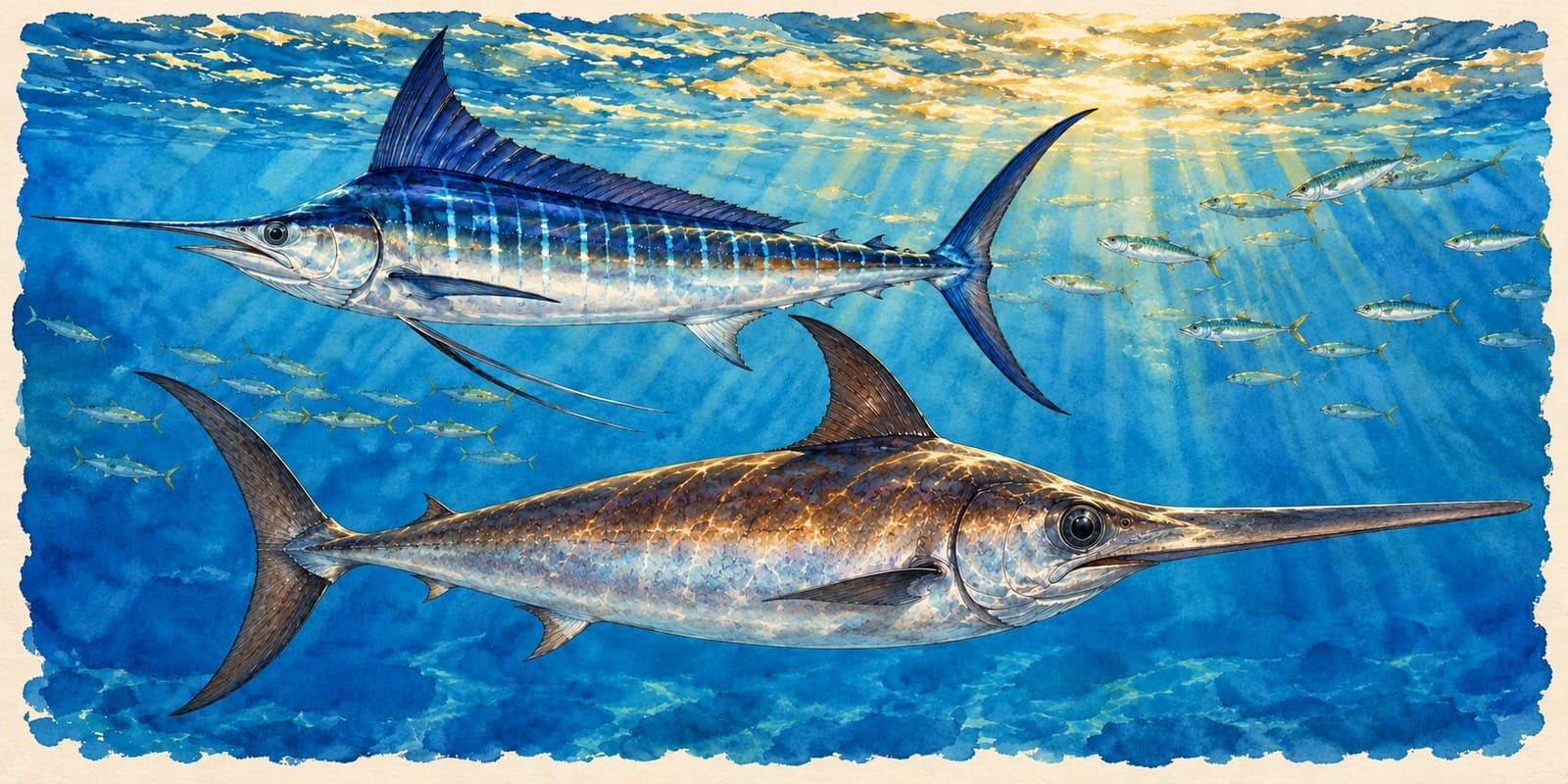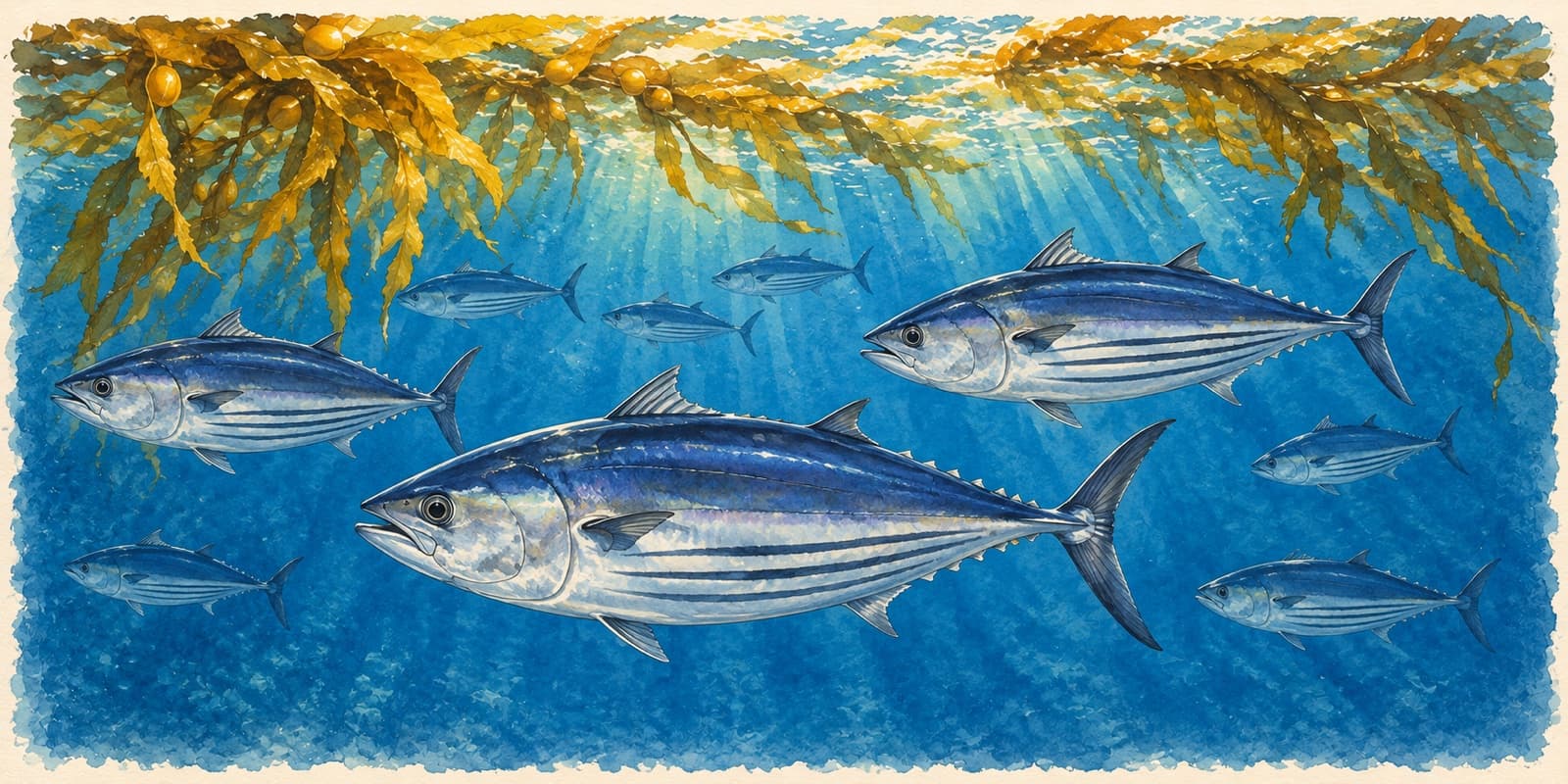
Skipjack are the tuna nobody books a trip for and everybody ends up catching in a warm summer. They come up in boils, hit anything in the spread, and leave as fast as they came. Treated as a nuisance, they waste your time. Read properly, they tell you a lot about the water you are fishing.
This is how skipjack behave off Southern California, how to tell them from the other small striped fish, and what to do with them once they are on the boat. For the basics, see our skipjack guide.
How to know it is a skipjack
A skipjack is a small, chunky tuna. Most here run 5 to 15 pounds. The tell is on the belly.
- Belly stripes. Four to six dark stripes run lengthwise along the lower sides and belly. No other local tuna has them.
- Plain back. The back is dark purplish blue with no stripes, spots or bars.
- Short fins. The pectoral fin is short, and the second dorsal and anal fins are small.
Three fish get confused with it:
- Bonito carry their stripes on the back, slanting up and back, over a plain silver belly. Our history of bonito in Southern California covers that fish and its boom years.
- School yellowfin often swim with skipjack. They have no belly stripes, and many show pale bars and spots on the lower sides and a gold stripe along the side. Our guide to telling yellowfin from bluefin covers the fins that settle it.
- Black skipjack, a warm-water cousin from Mexico, has its stripes on the back and a few dark spots on the lower side near the pectoral and pelvic fins. It is a rare sight this far north.
Warm water brings them
Skipjack are a tropical fish at the northern edge of their range here. The CDFW status report on skipjack describes a population that spawns in equatorial waters and sends one migrating group north to the Baja California grounds each year. During El Niño events, the report notes, they push much farther up the coast than usual. Off Southern California they mostly show once the water has warmed into the 70s.
The party boat record shows how much the water matters:
- 1983. CDFW logbooks recorded a high of 103,000 skipjack, during the strong 1982-83 El Niño.
- 1990. A second peak of 52,000 fish.
- 1998. Down to 14,000, even though 1997-98 was another big El Niño. Warm water opens the door. It does not promise the fish walk through it.
Recent warm years have followed the pattern. In the week of September 20 to 26, 2015, the San Diego fleet, most of it based in Point Loma, counted 3,055 skipjack alongside 15,401 yellowfin and 4,252 dorado, while the bluefin had moved out and north. That is the typical mix: skipjack rarely arrive alone.
Where they hold
Skipjack are surface fish that like structure in open water and edges between water masses.
- Under floating objects. In the eastern Pacific, CDFW notes, skipjack are most often found in surface schools gathered around floating objects. Here that means kelp paddies, the same ones that hold dorado and yellowtail. Our guide to fishing kelp paddies covers how to work one.
- On breaks and edges. They gather along temperature breaks, upwelling edges and other boundaries between warm and cool water.
- With birds and porpoise. They travel through the same bird schools and porpoise that hold the warm-water tuna.
- Mixed with school yellowfin. Yellowfin under about 40 inches often school with skipjack. A skipjack boil is worth a few casts to see what else is under it, and our fall yellowfin guide covers where those fish go as the water cools.
- The big ones run alone. Larger skipjack tend to travel in free-swimming schools rather than under paddies.
In a warm summer, the small tuna that hits the feathers on the offshore banks where boats once trolled for albacore is often a skipjack. Our history of albacore in Southern California tells how the old longfin fishery came and went.
How they bite
Skipjack are not fussy, and they feed hard. Stomach studies in the eastern Pacific found more pelagic crabs than fish, so a small bait or lure is usually closer to what they are eating than a big one.
- Trolled feathers and small jigs. The first strike on a troll in warm water is often a skipjack.
- Fly-lined sardine or anchovy. A small live bait thrown into a boil gets bit fast.
- Small iron or chrome. Cast into breaking fish and wind fast.
The schools move quickly. If a boil sinks out while you are re-rigging, it has probably moved on, not gone down to stay.
What to do with one
- Use it as bait. A fresh skipjack, live or as a chunk, is excellent bait for bigger tuna and for sharks.
- Or eat it, properly. The meat is dark, oily and spoils fast. Bleed it and get it on ice the moment it hits the deck.
- Count it. Check the current CDFW ocean sport fishing regulations for the limit. A lot of warm-year skipjack water is south of the border, including around the Coronado Islands, and fishing there needs a Mexican licence.
Where Fish or Pass fits
Skipjack are a profile species on Fish or Pass, not a graded one. The skipjack guide describes the fish. The Bite Score grades yellowfin, bluefin and dorado, and the warm water that brings skipjack is part of what those verdicts weigh. It cannot see a skipjack boil from the beach. That part is still on you, and on what comes up on the feathers.