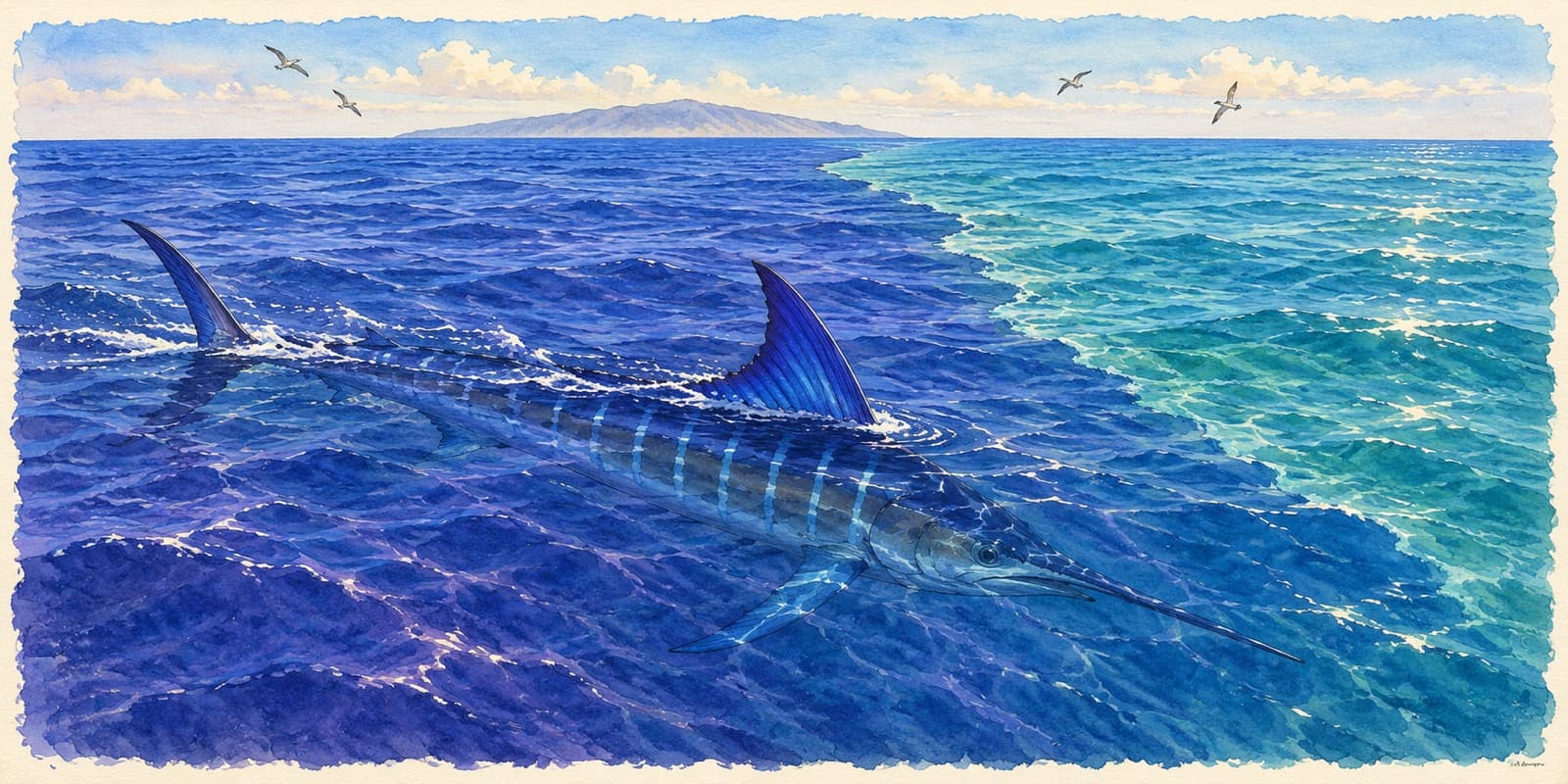
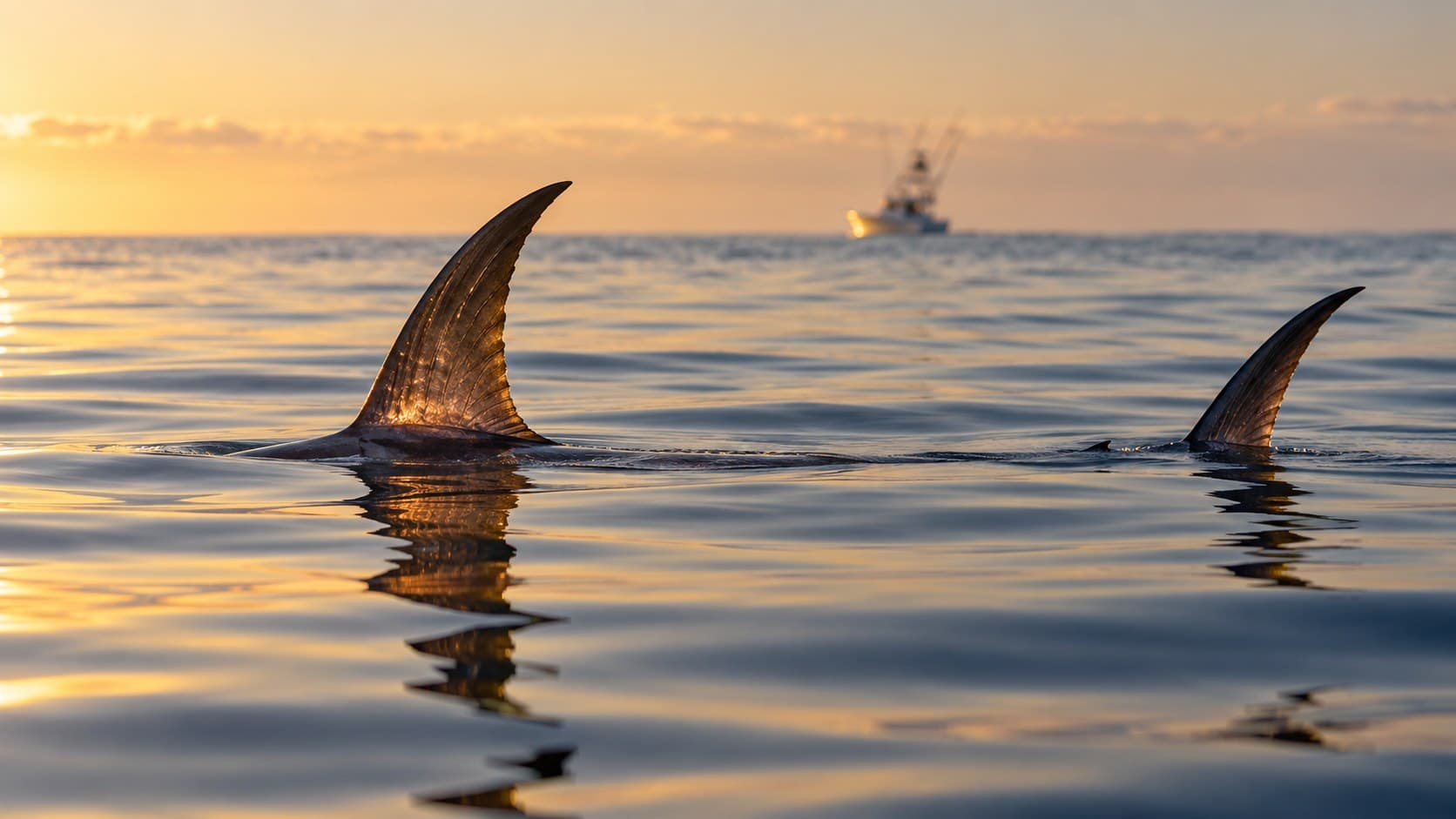
Two dark fins on flat blue water, a few feet apart, and somebody on the bridge says marlin. Somebody else says swordfish. Both fish are out there in the fall, both carry a bill, and from a hundred yards off they can look a lot alike. Up close they are not alike at all.
This post is about telling them apart: on the surface, at the boat, and in a picture somebody posts from last weekend. For the fish themselves, the striped marlin guide and the swordfish guide cover who each one is.
Why this comes up in the fall
The calendars overlap. The marlin guide puts the striped marlin season at July through October, with the peak in September. The swordfish guide puts the best swordfish months at August through November. So October is the month when an offshore crew working the banks for marlin is most likely to run into a swordfish instead.
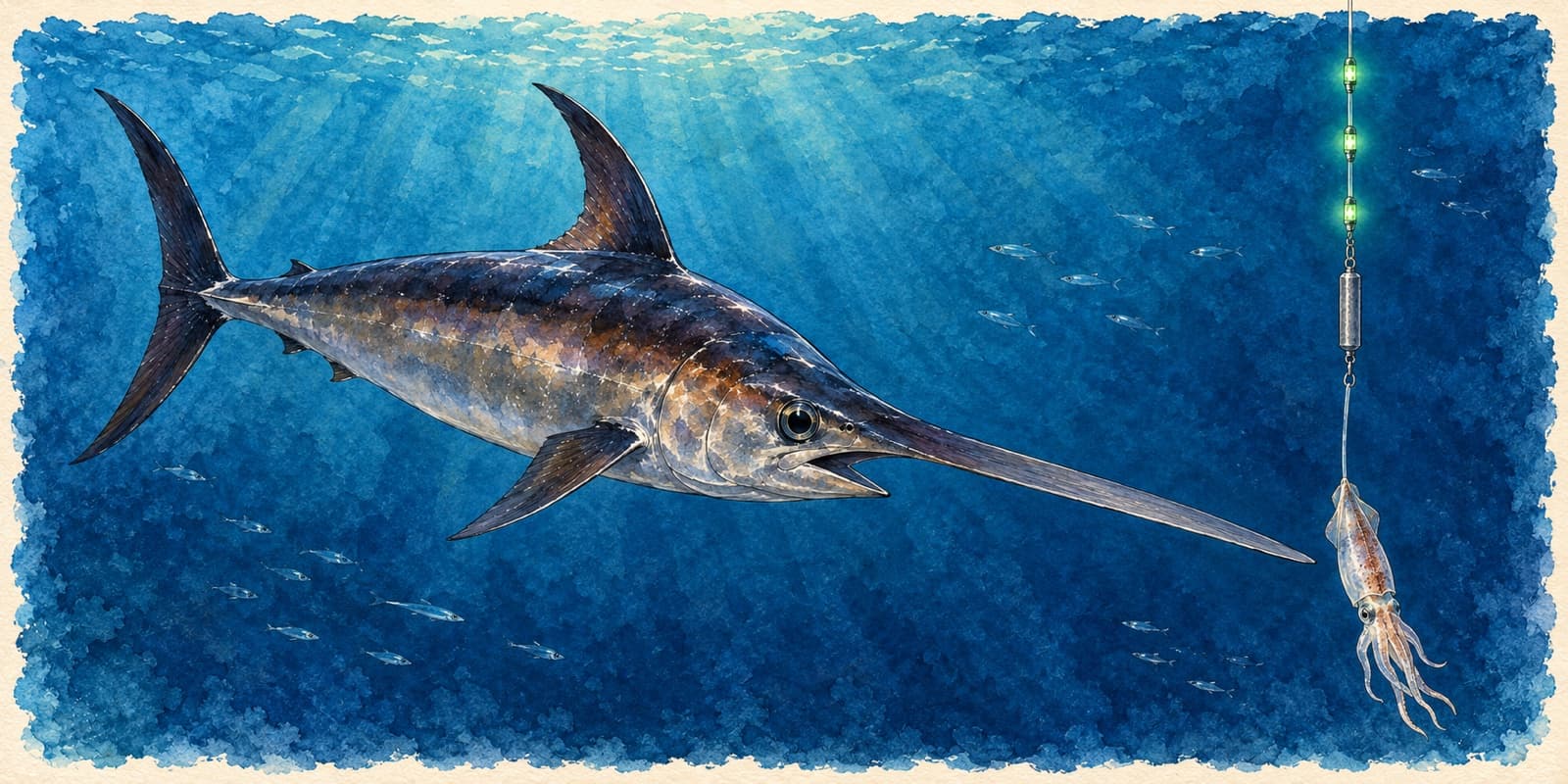
They live differently, which is the first clue. Striped marlin are summer visitors that ride warm water up from Mexico and hunt near the surface on the offshore banks. Swordfish spend the day deep, often below a thousand feet, and rise toward the surface at night to feed on squid. A marlin on top in the daytime is normal. A swordfish on top in the daytime is a fish doing something a little unusual, which is part of why it is worth recognizing.
The bill
This is the clearest difference and the one that gives the swordfish its other name.
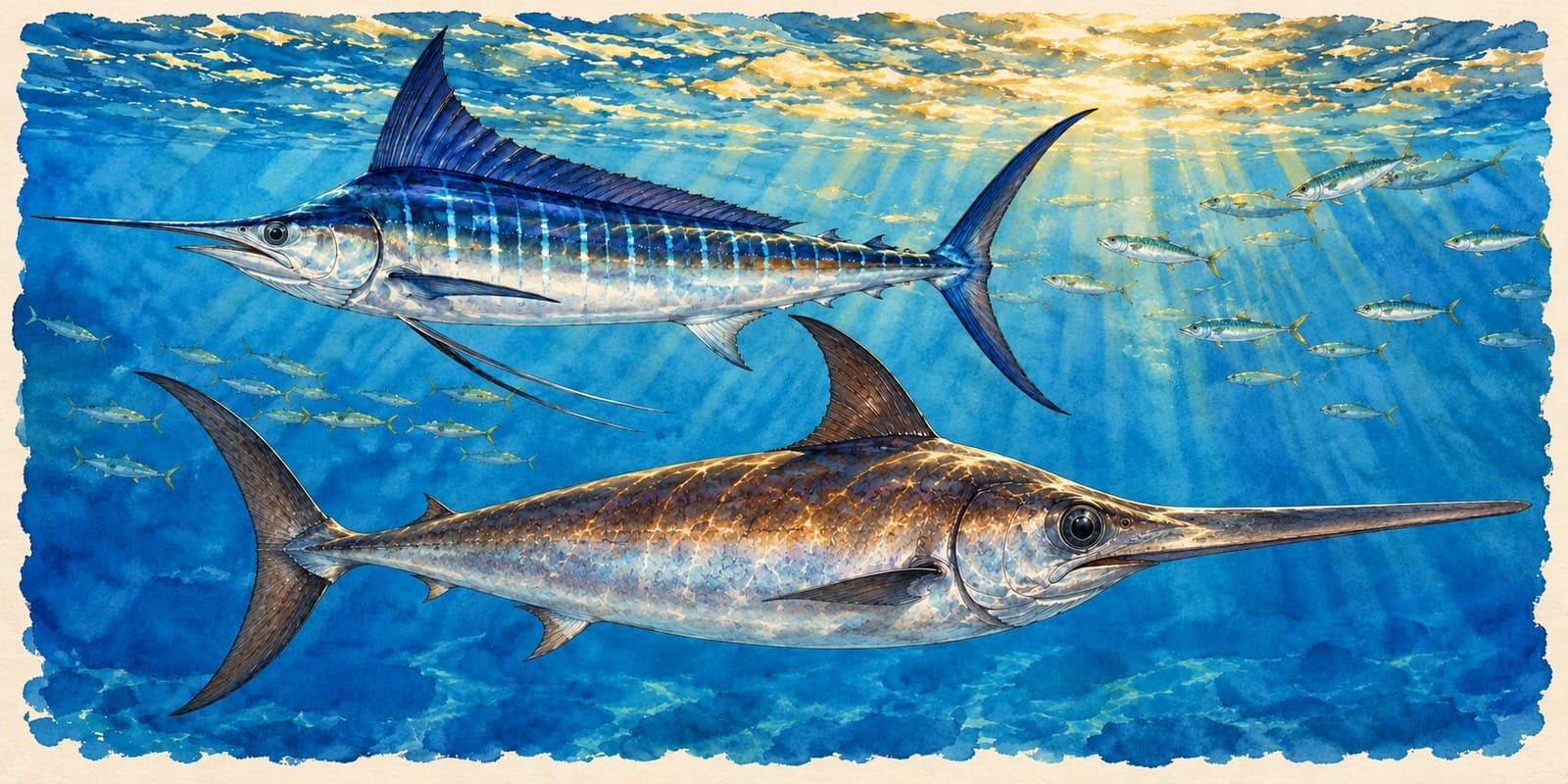
- Swordfish: flat and wide. The bill is long and flattened like a blade, wider than it is thick. That is the broadbill.
- Marlin: round and slimmer. A striped marlin's bill is round in cross-section, like a spear, and shorter relative to the fish.
If you can see the bill, you usually do not need anything else. In the water you often cannot, which is why the rest of this list matters.
The dorsal fin
Both fish have a tall first dorsal fin. They do not carry it the same way.
- Swordfish: rigid, always up. A broadbill's first dorsal is a stiff, dark sickle that rises sharply from the back and stays up. The fish cannot fold it down. Behind it on an adult there is a long bare stretch of back, with only a tiny second dorsal near the tail.
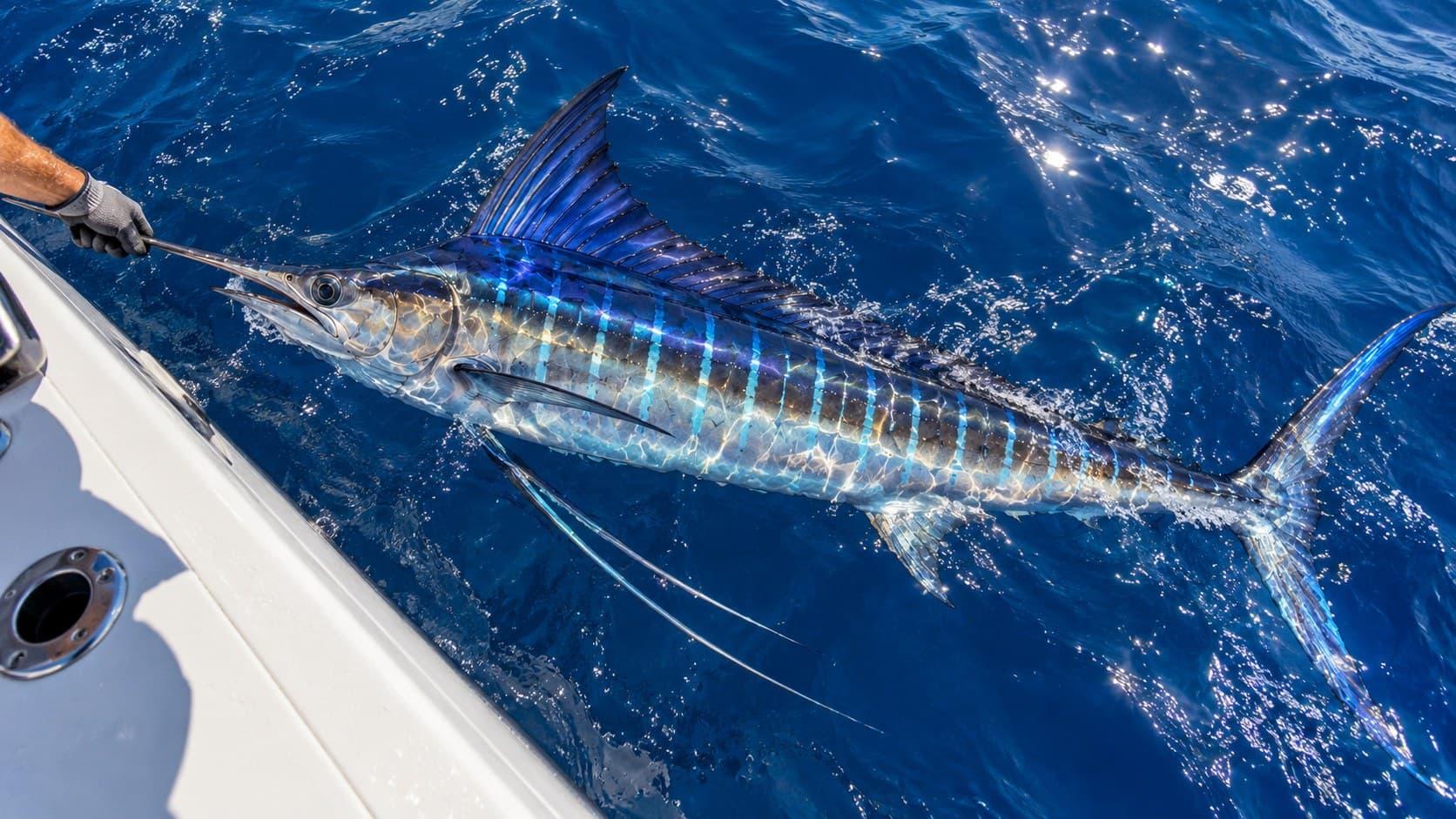
- Marlin: tall in front, and it folds. A striped marlin's dorsal is tall and pointed at the front and runs a long way back along the body. The fish can lay it down into a groove along its back, and it often does when cruising. When a marlin lights up to feed, the fin goes up and turns bright cobalt.
Fins, keels and skin
Get one to the boat and the details settle it.
- Pelvic fins. A marlin has a pair of long, thin pelvic fins hanging under its chest. A swordfish has none.
- Keels. Look at the base of the tail. A swordfish has a single large keel on each side. A striped marlin has two smaller keels on each side.
- Scales and teeth. An adult swordfish has no scales and no teeth. The skin is smooth and leathery. A marlin has small, embedded scales.
- The eye. A swordfish's eye is huge, about the size of a fist on a big fish, built for seeing in water with almost no light. The swordfish guide notes a heat exchanger beside the brain and eyes that keeps them warm enough to work in cold, deep water.
Color
Color helps, but do not lean on it alone. Fish change color fast, especially when they are excited or dying.
- Swordfish: dark above, often a chocolate brown to bronze or purple, fading to pale sides and belly. No stripes.
- Striped marlin: dark blue back and silver sides with pale blue vertical stripes that stay visible even after the fish is dead. When it is feeding or hooked, the stripes and fins light up electric blue.
If it has stripes, it is a marlin. If it has no stripes and a flat bill, it is a swordfish.
Reading fins on the surface
This is where most of the arguments happen, because on the surface you usually see two fin tips and nothing else.
Marlin show themselves a few ways off Southern California. Our post on how to catch marlin breaks it down, but the short version: tailers swim fast down-swell and down-wind with the dorsal and tail tips out, and sleepers lie on top barely moving. A sleeping marlin often shows less dorsal than you would expect, because the fin can be partly folded.
A swordfish on the surface is usually doing what the old-timers called basking: lying still or slowly finning on a calm day. What you see is two fins, a stiff, dark sickle of a dorsal and the top lobe of a big crescent tail, with clear water between them. Because the dorsal cannot fold, it stands up tall and stays that way. For most of the last century, sneaking up on one of those fish with a bait was the only way anyone here caught a swordfish, and it rarely worked. The deep-drop swordfish post explains how that changed.
A few practical rules for the surface:
- Fins that stay up and do not move much on a flat afternoon point toward a swordfish.
- Fins moving with purpose down the swell point toward a marlin.
- Get the glasses on it before you call it. A pair of binoculars ends more arguments than anything else on the boat.
Other fins out there
Not every pair of fins is a billfish. The fall offshore water has a few other fish that show fins on top.
- Sharks. A mako or blue shark shows a triangular dorsal and, behind it, the tip of the tail swinging side to side. Shark fins sweep. Billfish fins mostly hold still or slice straight.
- Thresher. The upper lobe of the tail is as long as the rest of the shark, and it shows. Our post on the thresher shark covers that fish.
- Ocean sunfish. The mola lies on the surface and flops a single tall fin back and forth. It looks odd enough that once you have seen one you will not confuse it with anything else.
Once it is hooked
The fight usually tells you before the fish is anywhere near the boat.
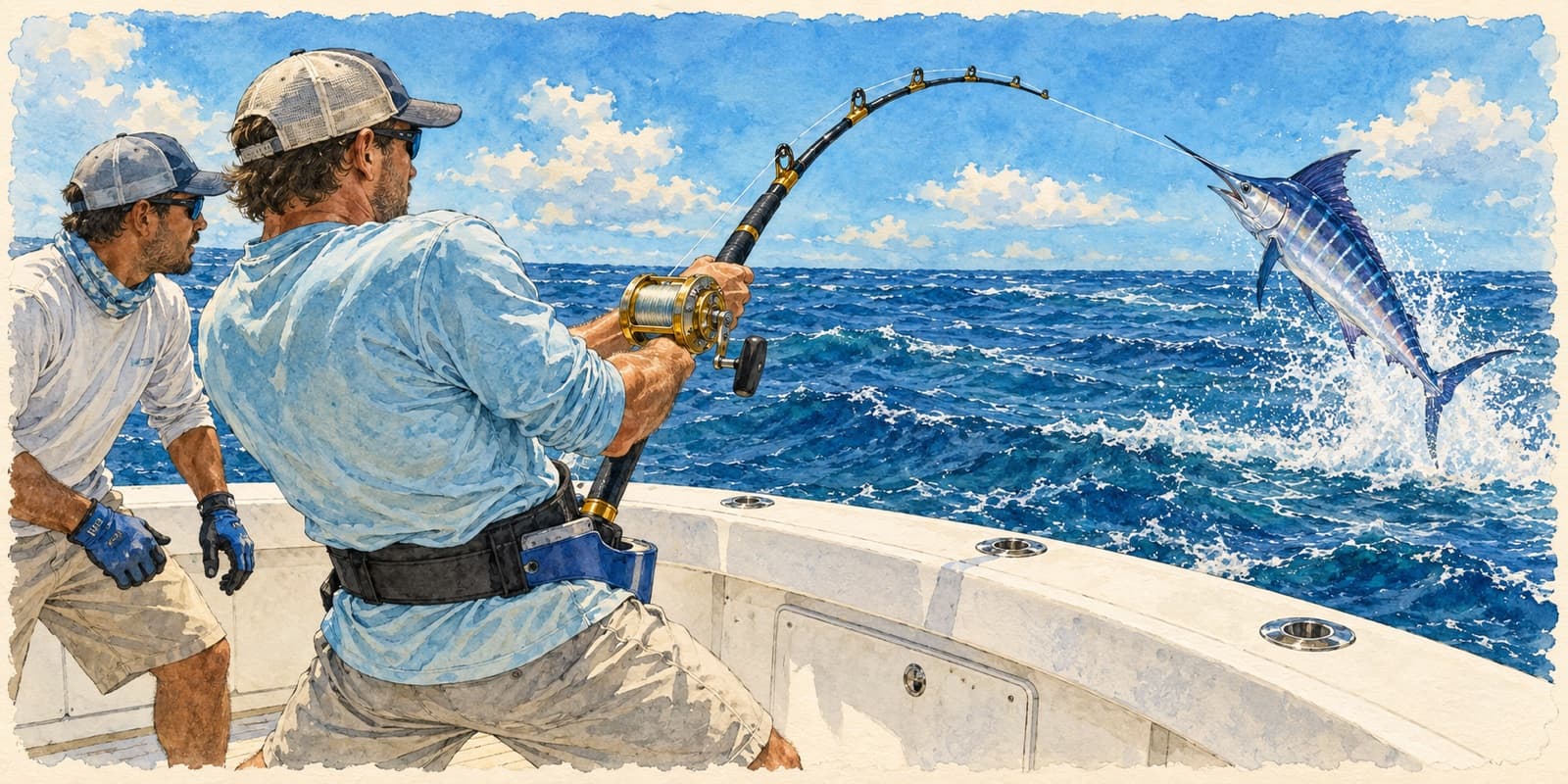
- Marlin jump. A hooked striped marlin tends to go into the air early and often, greyhounding across the surface and tail-walking. Most SoCal marlin run 90 to 150 pounds, according to the marlin guide.
- Swordfish go down. A broadbill fights deep and long, and its mouth is soft, so hooks pull. The swordfish guide puts typical fish at 100 to 300 pounds, which makes for a lot of time on the rod. Be careful at the boat. That flat bill swings, and it is sharp along the edges.
The rules are different too
The two fish are managed differently. Marlin have been sport-only in California since 1937 and nearly every one is released. Swordfish fall under federal and state rules for highly migratory species, and the bag limits for the two are not the same. Check the CDFW ocean sport fishing regulations before you keep either one. Knowing which fish you have on matters for that reason alone.
Plenty of marlin crews release every fish and plenty of swordfish crews keep theirs. Know which one you have before anybody reaches for a gaff.
Where Fish or Pass fits
The Bite Score grades striped marlin as Catching, Fishing or Pass from surface water temperature, sea conditions and recent reports, for the banks within reach of Point Loma, Dana Point and Newport. It does not grade swordfish. A fish a thousand feet down lives in water no surface reading describes, and no score can tell you whether that pair of fins on the horizon is a marlin or a broadbill. That part is still you, the binoculars and a good look at the bill. For more on when the marlin show, read marlin season in Southern California, and if you like this kind of ID question, yellowfin or bluefin is the tuna version.