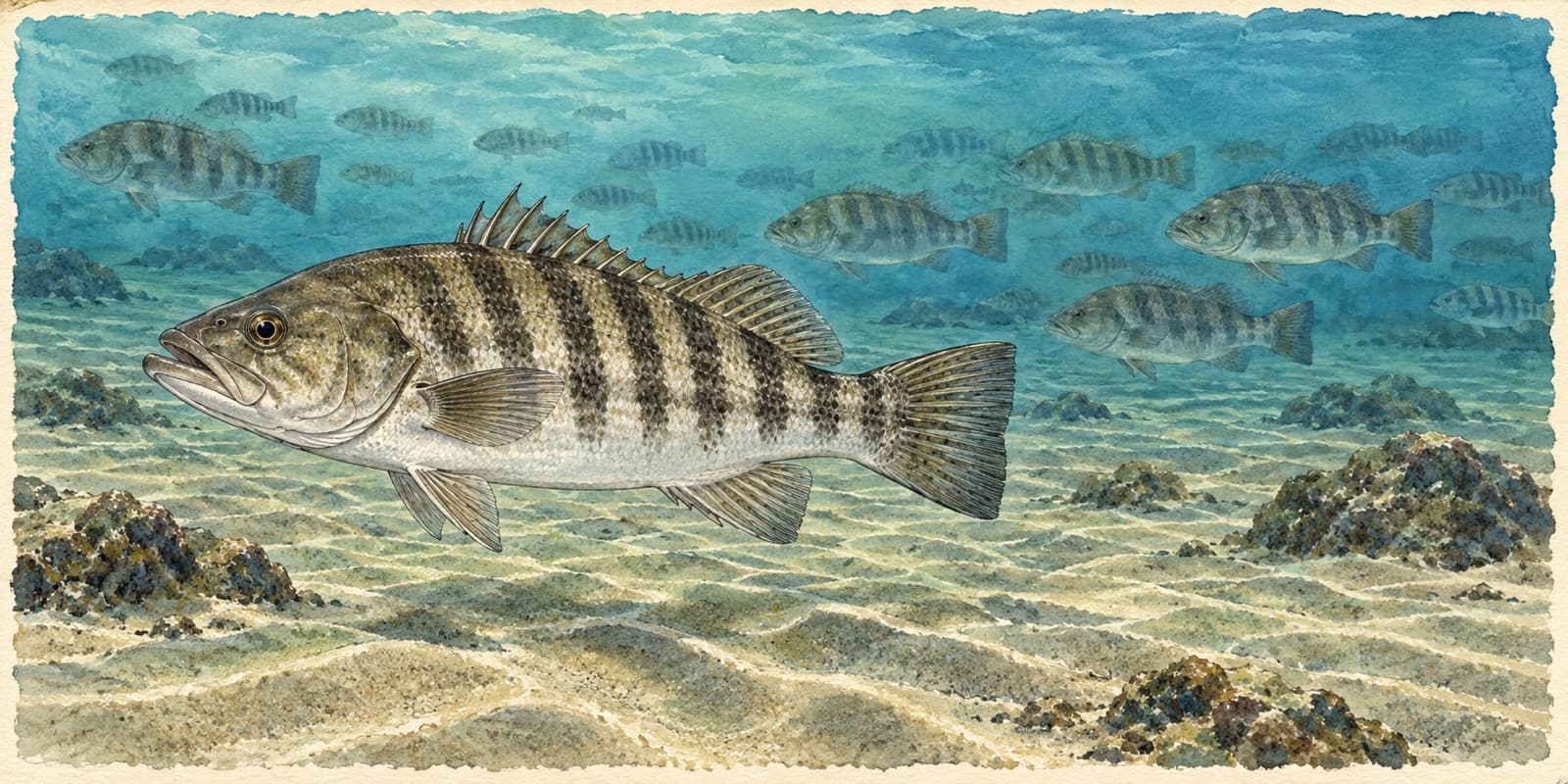
For most of the year a barred sand bass is a homebody. It lives on a small patch of bottom where sand meets reef, stays close to the seafloor, and does not wander far. Then summer comes, and a share of the fish in a region swims miles to the same stretch of open sand, gathers into schools you can see on a sounder, and spawns. For a few weeks the most scattered bass on the coast becomes the easiest one to find.
That is the whole summer sand bass fishery, and the whole problem with it. This post covers what the fish are doing on the flats, which flats they have used, why the bite turns on and off with the boat still sitting on them, and why the spawn you fish today is not the one your father fished. For the basics on the fish itself, start with the barred sand bass species guide.
The rest of the year: a fish with a small address
Outside the spawn, adult sand bass live at the edge of structure. CDFW's status report describes them on the sand and reef interface of natural and artificial reefs, typically in about 65 to 100 feet of water, and tracking studies put their home ranges at somewhere between a few acres and about 60 acres. They are bottom fish in the strict sense. Tracking work found they rarely rise more than about 6 feet off the bottom outside the spawning season.
That is why a winter or spring sand bass is a fish you find one at a time, usually while fishing for something else. They are on the same reefs and breakwaters that hold calico bass, just lower and closer to the sand.
The summer move
As inshore water warms, part of the population leaves home. Tag and recapture records kept by the state since the 1960s show the fish traveling on average roughly 8 to 10 miles from their home reefs to an aggregation site, and many return to the same site year after year. The schools are a mix of local fish and fish that have come in from elsewhere. Individual bass seem to stay on a site for one to five weeks, spawning repeatedly, before heading back.
CDFW says the aggregations form predominantly in July and August. On a warm year the first fish show in June, which is why the Newport post describes the bite building in early summer when inshore water sits in the mid to high 60s.
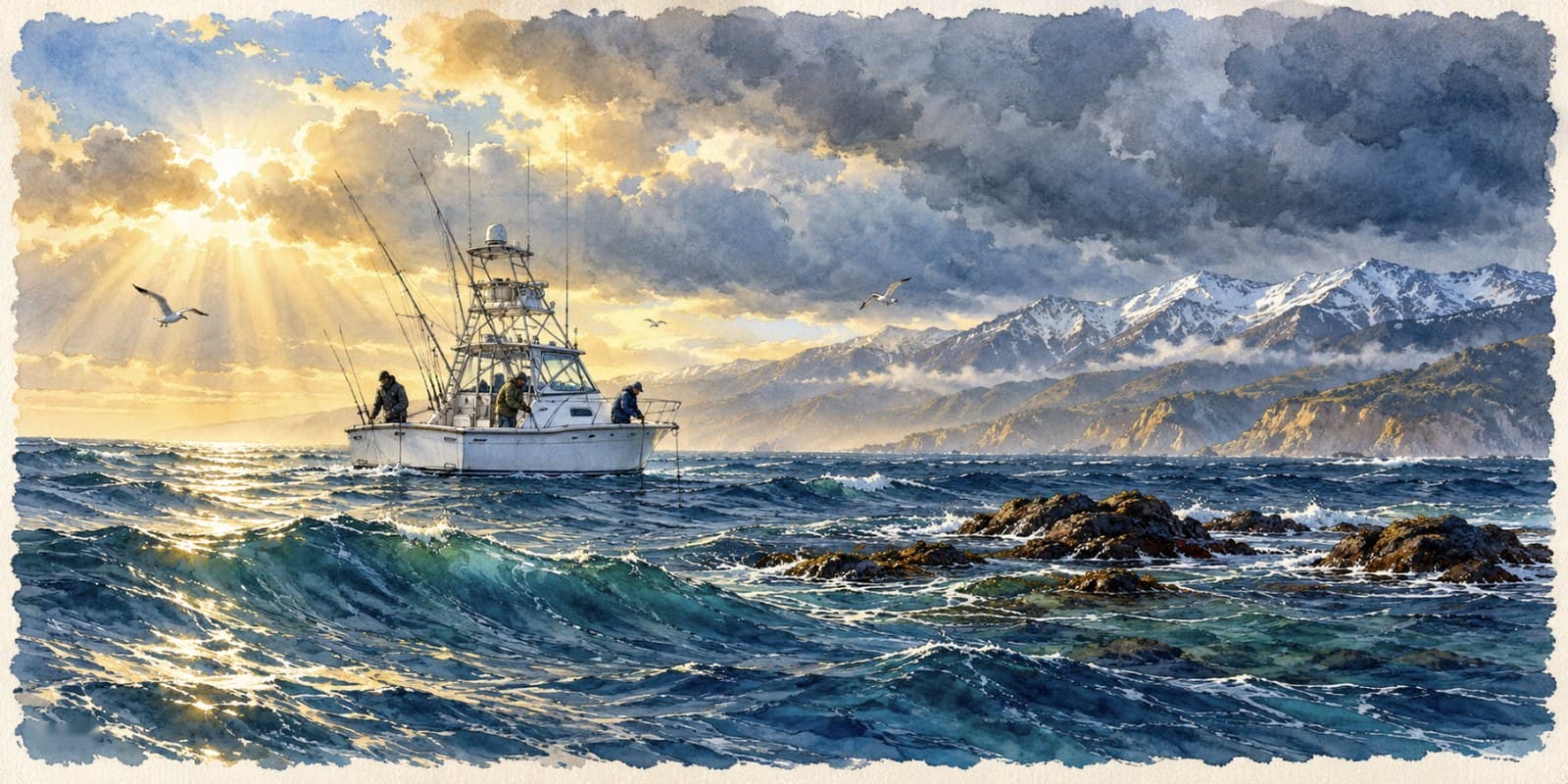
The sites are open sand and mud with scattered patch reef, not the kelp. The ones CDFW lists as historic spawning grounds:
- Huntington Flats, off Huntington Beach, fished by boats out of Long Beach and Newport. The best known of them all.
- Santa Monica Bay, on the inner bay's sand.
- Ventura Flats, off northern Ventura County, close to Channel Islands Harbor and Ventura.
- San Onofre and Del Mar in San Diego County.
- The Silver Strand, off Coronado, a short run from Point Loma.
The same report adds a blunt note: because the aggregations have shrunk and become hard to find, many of these spots have not been targeted much in recent years.
What the haze on the meter is
Anglers describe a spawning school as a haze a few feet off the bottom. The science explains why it looks that way. Acoustic tracking of individual fish during the spawn found them following temperature gradients in the water column and making repeated vertical dives toward the seafloor to release eggs and sperm during the day. Females are batch spawners. They ripen eggs through the season and spawn many times over several days.
State researchers working the San Pedro Shelf found spawning peaked in the morning, in warm water, in the days leading up to the new and full moons. That lines up with what crews have long said about the bite: it comes in bursts. A school that ate for an hour around a tide change can sit under the boat afterwards and ignore everything, because the fish are there to spawn, not to feed.
Practical takeaways from that:
- Marks are not the same as biters. A big school on the meter tells you the fish are there. It does not tell you they are eating.
- Time on the spot matters. The bursts are short. Being on the school when one starts is most of the game.
- Mornings and moon phase are worth noting in your own log, alongside the tide, so you can see whether your flats follow the same pattern.
How the spawn gets fished
The methods are simple, and they have not changed much.
- Plastics on a leadhead. A swimbait or grub on a jighead heavy enough to reach the bottom in the depth you are fishing, swum slowly just off the sand through the school. Many of the same baits in our calico swimbait and plastics guide work here.
- Live bait. An anchovy or sardine on a light leader, dropped into the haze and left alone, or fished on a dropper loop just above the sinker.
- Bottom baits. Tube baits and dead squid dropped to the bottom. When the San Diego short-run boats worked the flats during a strong week of sand bass fishing in July 2025, those and live bait were what the reports said worked.
On a crowded spot, keep your weight heavy enough that your line goes straight down. A school of sand bass draws a fleet, and a rig that scopes out behind the boat tangles your neighbors.
Why the spawn is smaller than it was
The summer aggregations made sand bass one of the most caught fish on the coast for decades. They also made the fishery hide its own decline.
A 2011 study by Erisman and colleagues, published in the Canadian Journal of Fisheries and Aquatic Sciences, found that the biomass of both barred sand bass and kelp bass had fallen about 90 percent since 1980, while catch rates on the boats held steady for years. The reason was the aggregations. When the fish pack onto a few spots, boats keep finding them and keep catching them at the same rate, even as the total number of fish drops. The authors called it the illusion of plenty.
The ocean matters too. CDFW notes that sand bass larvae survive best during long runs of warm water and that the fish recruit well in El Niño years, while cool periods leave them most exposed to overfishing. Commercial fishing for sand bass was banned in 1953, and the bass have been managed together with calico and spotted bay bass since the early 1900s. The size and bag rules were tightened in 2013, and in 2025 the Fish and Game Commission cut the sand bass limit again on a temporary basis. CDFW currently describes the southern California population as severely depressed. Read the CDFW barred sand bass status report for the detail, and the CDFW ocean fishing regulations for the current limits before you keep one.
None of that means you cannot fish the spawn. It means fishing it well includes deciding what you keep. A big female on the flats in July is carrying the next generation. If you release fish, handle them with wet hands, keep them out of the water briefly, and get them back down quickly.
Where the young fish end up
The eggs drift, and the young that survive settle in sheltered water. CDFW notes that juvenile sand bass are common over shallow sand and eelgrass in bays and estuaries, which is why anglers working the bays for spotted bass often catch small sand bass too. If that is your kind of fishing, our guide to spotted bay bass on light tackle in the bays covers the bass that never leaves.
The flats are also next door to the bottom fishing. When summer ends and the bass scatter back to the reefs, a lot of the same boats turn to the rock, and sculpin and their spines become the fish of the cooler months.
Where Fish or Pass fits
The barred sand bass guide is a profile of the fish. The Bite Score does not grade sand bass. It grades calico bass, which share the warm months and much of the same coast, reading water temperature, sea conditions and recent reports for each day as Catching, Fishing or Pass. A warm, settled week that lifts the calico verdict is often the same week the flats start to show fish. The score cannot see a school on the sand, and it cannot make one feed.