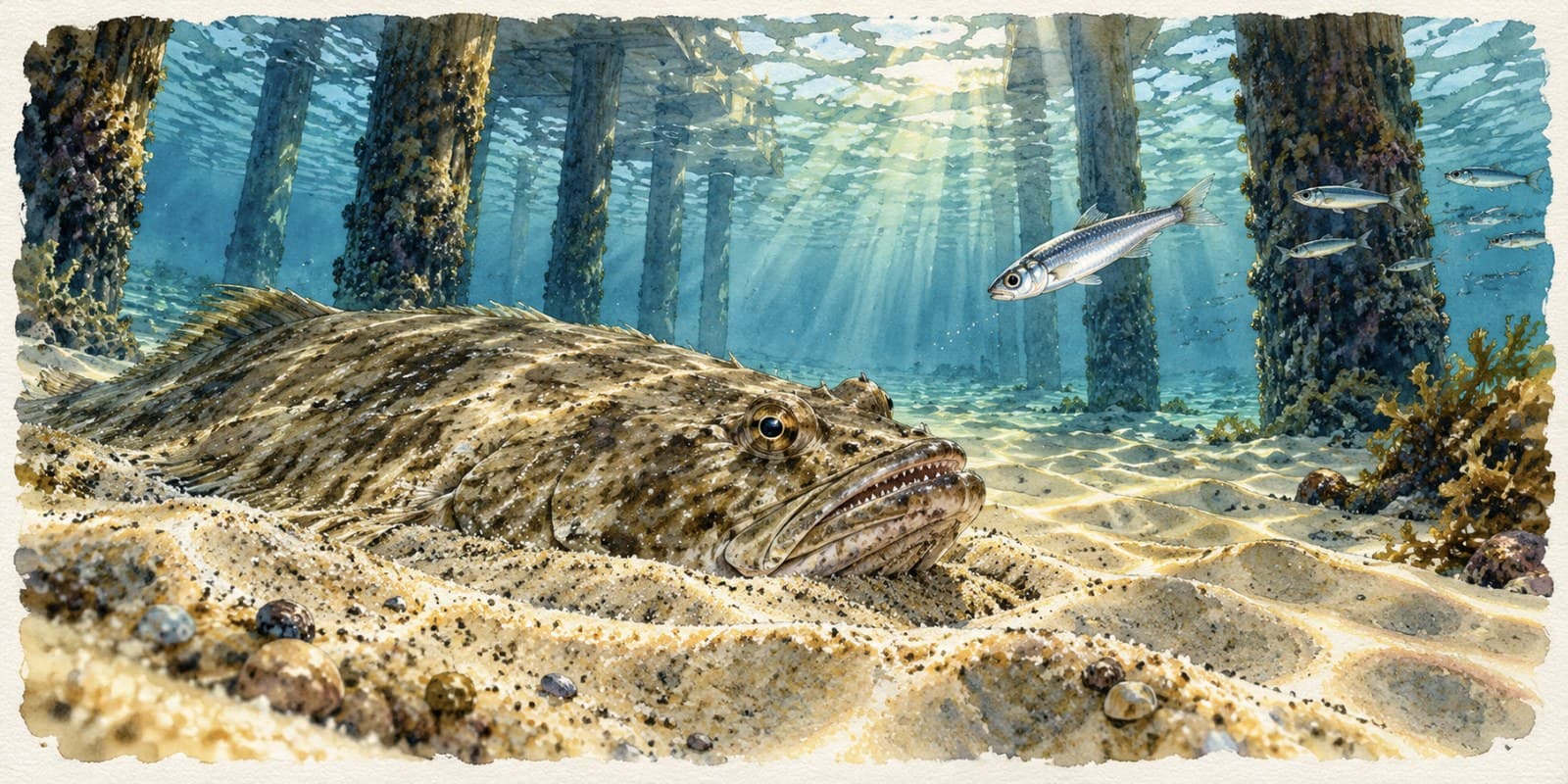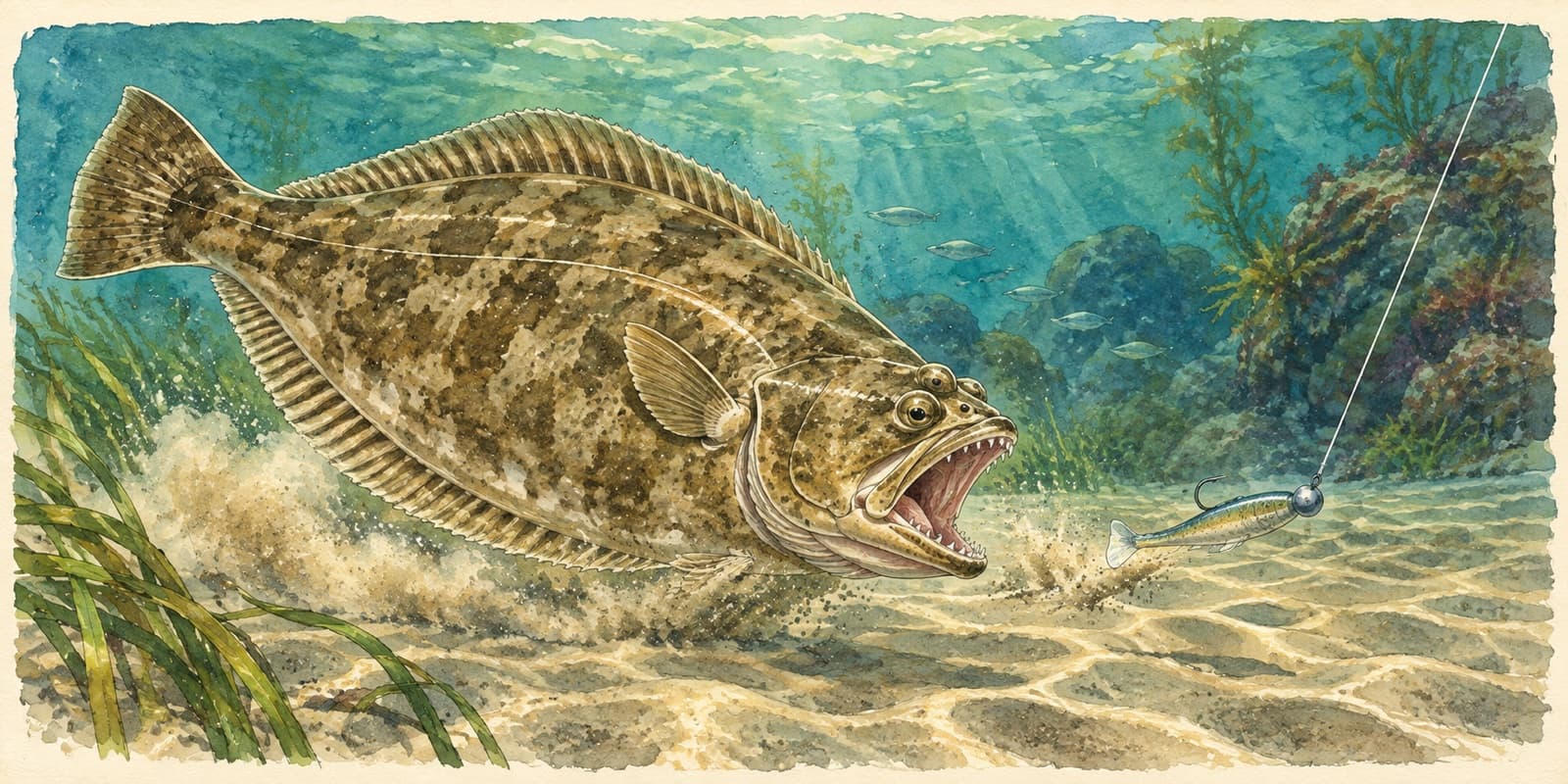
A California halibut does not chase. It lies buried in the sand with its eyes up, waits for something to pass overhead, and comes straight up off the bottom to eat it. Everything about fishing for one follows from that. You have to bring the bait to the fish, low and slow, across the sand where it is lying.
That is why halibut anglers drift instead of anchoring, and why the two methods that catch the most fish are a live bait dragged along the bottom and a swimbait bounced across it. This is a plain guide to both. For the fish itself, see the California halibut species guide. Fishing from land instead? Our post on catching halibut from piers, beaches and jetties covers that side.
Where to drift
Halibut live on sand, but they do not spread evenly over it. They stack up where the sand meets something else.
- Transitions. Sand against reef, sand patches inside rock or kelp, the edge where a flat drops into deeper water.
- Structure edges. The up-current side of wrecks, reefs, jetty tips and breakwaters.
- Bays and channels. Bay mouths, channel edges and eelgrass, where bait gets pushed around by the tide.
The classic Southern California halibut water includes Santa Monica Bay, the Ventura flats, Huntington Flats, the sand along the Silver Strand, and the bays: San Diego, Mission, Newport and Alamitos. The Marina del Rey guide covers the Santa Monica Bay side, and the port guides for Channel Islands, Long Beach, Newport and Point Loma cover the rest.
Most halibut are caught in about 10 to 90 feet. In spring the adults move inshore to spawn in roughly 16 to 60 feet of water, which is why the species guide gives March through July as the best months and why shallow flats can be so good then. When you catch one, mark the spot. Where there is one there are often more.
Drift speed is the whole game
A halibut will not chase a bait that is flying past. Somewhere around half a mile an hour to a mile and a half an hour over the bottom keeps the bait down in the zone and moving slowly enough for a fish to eat it.
- Too fast? Put out a drift sock, or two, off the windward side. Fish heavier weight so the bait stays on the bottom.
- Too slow? With no wind or current, bump the engine in and out of gear, or use a trolling motor, to keep the bait crawling.
- Line angle. Your line should run down at a steep angle, not stream out behind the boat. If it is scoping out, add weight.
Drift across the transition, not along the middle of a featureless flat. Weaker tides and light wind usually make the easiest drifts.
Rigging a live bait
Two rigs do almost all the work.
- Carolina rig. An egg sinker sliding on the main line above a small swivel, then two to three feet of leader to the hook. Good in bays and shallow flats where you need only a few ounces.
- Sliding sinker. A plastic sinker slider on the main line holding a torpedo or bank sinker. Use it when you need more than about three ounces, in deeper water, or to keep a big bait pinned to the bottom.
Either way, use a fluorocarbon leader in the 15 to 25 pound range. Halibut have real teeth and they shake their heads.
Hooks. A J-hook from about 1/0 to 3/0, or a 2/0 to 4/0 circle hook, through the nose of the bait. For bigger baits, add a trailing stinger hook in the side or back of the bait. A treble stinger hooks more fish but makes it harder to release a short one cleanly.
Bait. Anchovies and sardines from the bait barge are the standard. Small Pacific mackerel, jack mackerel, topsmelt and squid all work, and five to eight inches is a good bait size. When market squid are spawning on the sand, a live squid is a fine halibut bait, and the white seabass and squid spawn post covers where and when that happens.
Swimbaits: covering the flat
A swimbait does the same job as a live bait but lets you cover more sand and cast to the edges a drift will not reach.
- The setup. A paddletail swimbait on a leadhead heavy enough to touch bottom. That ranges from about 1/8 ounce in a calm harbour to an ounce and a half on a deeper flat with current.
- Colour. Match the bait: anchovy, smelt and sardine shades, plus white.
- The retrieve. Cast ahead of the drift, let it hit the bottom, then drag and hop it back with short lifts so it puffs sand and settles. Fish it faster than you would a live bait. Halibut often eat on the drop.
- Calm water. Swimbaits shine in bays, harbours and lagoons and on calm days outside.
Curly-tail grubs dragged slowly over sand on a light darthead catch halibut too. If you already throw plastics for kelp bass, the calico bass swimbait guide covers leadheads and retrieves, and the same outfit will catch a halibut.
Ball-bouncing: trolling the bottom
Some boats troll for halibut instead of drifting. A heavy cannonball sinker, one and a half to two pounds, bounces along the bottom on a short leg of a three-way swivel. A chrome dodger on a longer leg sets up a flashing wobble, and a hoochie, a soft plastic or a live sardine trails behind it. The boat runs at roughly one and a half to two and a half miles an hour, with enough line out that the weight touches bottom a few times a minute. It works best in water shallower than about 100 feet.
The bite and the hookset
A halibut bite is often just weight: the rod loads, and something that was not there is now there.
- On live bait with a J-hook, give the fish time. Free-spool or open the bail and let it run for five to ten seconds before you set. Big halibut tend to eat the bait right away, but smaller fish often grab it by the tail and need a moment to turn it.
- On a circle hook, do not swing. Just wind down until the rod loads.
- On a swimbait, set when you feel it. The fish already has the hook.
Bringing it in
A halibut usually makes one long run and then comes up like a heavy, flapping door. Wind steadily and do not pump the rod. Pumping makes the fish shake its head, and that is how hooks pull and leaders get cut on teeth.
Back the drag off a little as the fish nears the surface. A halibut that sees the boat often finds one more run. Have a big landing net ready and get the fish in head first. A net lets you measure a fish and release it if it is short. The minimum size is not small, so carry a measuring board and check the current rules in the CDFW Southern region regulations.
One more thing to check before you keep a small flatfish: a baby halibut and a sanddab look alike in the bag. The jaw tells you which is which, and the sanddab fishing post shows how.
Where Fish or Pass fits
The halibut guide is a profile, not a daily grade. The Bite Score reads conditions for the graded species, and for a halibut angler the closest is calico bass, which lives on the reef and kelp edges that the best halibut drifts run along. It cannot set your drift speed or tell you when a halibut is chewing on the tail of your sardine.