Nobody books a trip for sanddabs. But ask the people who clean fish at the end of the day what they are happiest to see in the sack, and plenty will point at the little brown flatfish. Sanddabs are easy to catch once you find them, they bite in doubles and triples, and they are some of the best eating in the ocean.
The trick is knowing where to drop and how to rig. This is a plain guide to both, from the deep mud off Santa Barbara to the piers that sit on top of submarine canyons. For the fish itself, see the sanddab species guide.
Which sanddab is on the hook
Three sanddabs live in the Bight, and you can catch all of them.
- Pacific sanddab. The biggest of the three and the one most people mean. Light brown with yellow and orange mottling, a small mouth and plain fins. Most run well under a foot.
- Longfin sanddab. Common in Southern California. The giveaway is the pectoral fin on the eyed side: it is dark, nearly black, and longer than the head.
- Speckled sanddab. A small fish of shallower water, tan to olive and peppered with black specks.
All three are left-eyed: lay the fish dark side up with its belly toward you and the head points left.
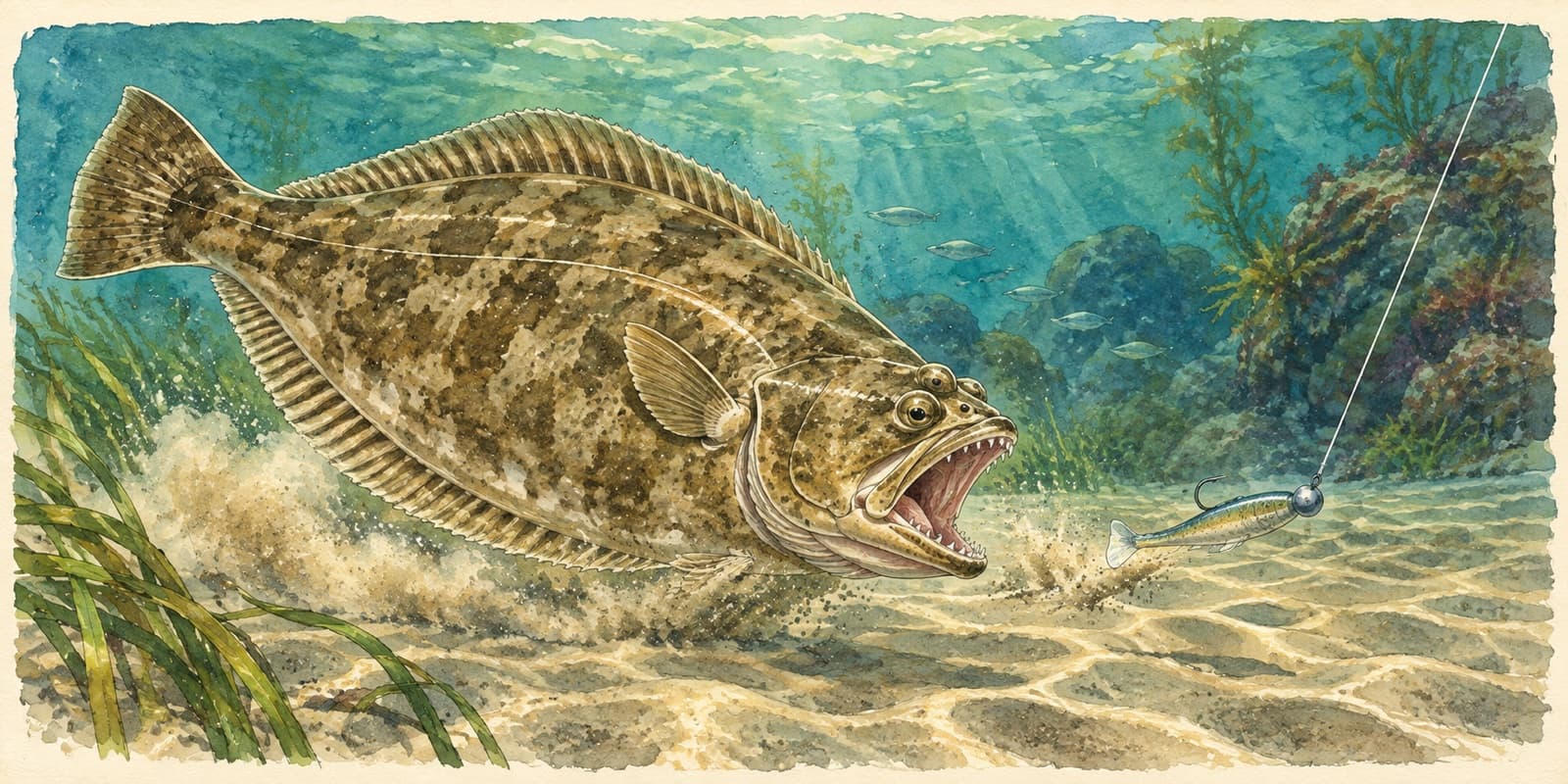
Check every small flatfish before it goes in the bag, because a baby California halibut can look a lot like a sanddab. A sanddab's mouth is small and stops short of the eye. A halibut's jaw runs back past the eye, it has a mouth full of teeth, and its lateral line arches high over the pectoral fin. Halibut have a minimum size, so a small one goes back. The halibut drifting and swimbait guide covers catching the bigger flatfish on purpose.
Where they live
Sanddabs want soft bottom: mud and fine sand, usually somewhere between 120 and 600 feet, on the featureless ground between the reefs. Many skippers like 200 to 300 feet, deep enough to find good numbers and shallow enough to fish with ordinary gear.
- Santa Barbara Channel. The mud flats off Ellwood in 250 to 300 feet, the flats out toward the oil platforms off Santa Barbara, and the deeper edge of the Ventura flats. The Santa Barbara and Channel Islands port guides cover the landings.
- Canyon piers. A few piers sit near the head of a submarine canyon, which brings deep water close enough to reach. Newport and Balboa piers, the Redondo piers and Port Hueneme pier all give up sanddabs, longfins especially. See the Newport port guide.
- Between the hard spots. Anywhere along the coast, the mud you motor across on the way to the reef is often full of them.
Sanddabs are available year round, which is part of what makes them useful: when the surface fish have gone and the reef is slow, the mud is still there.
The rig
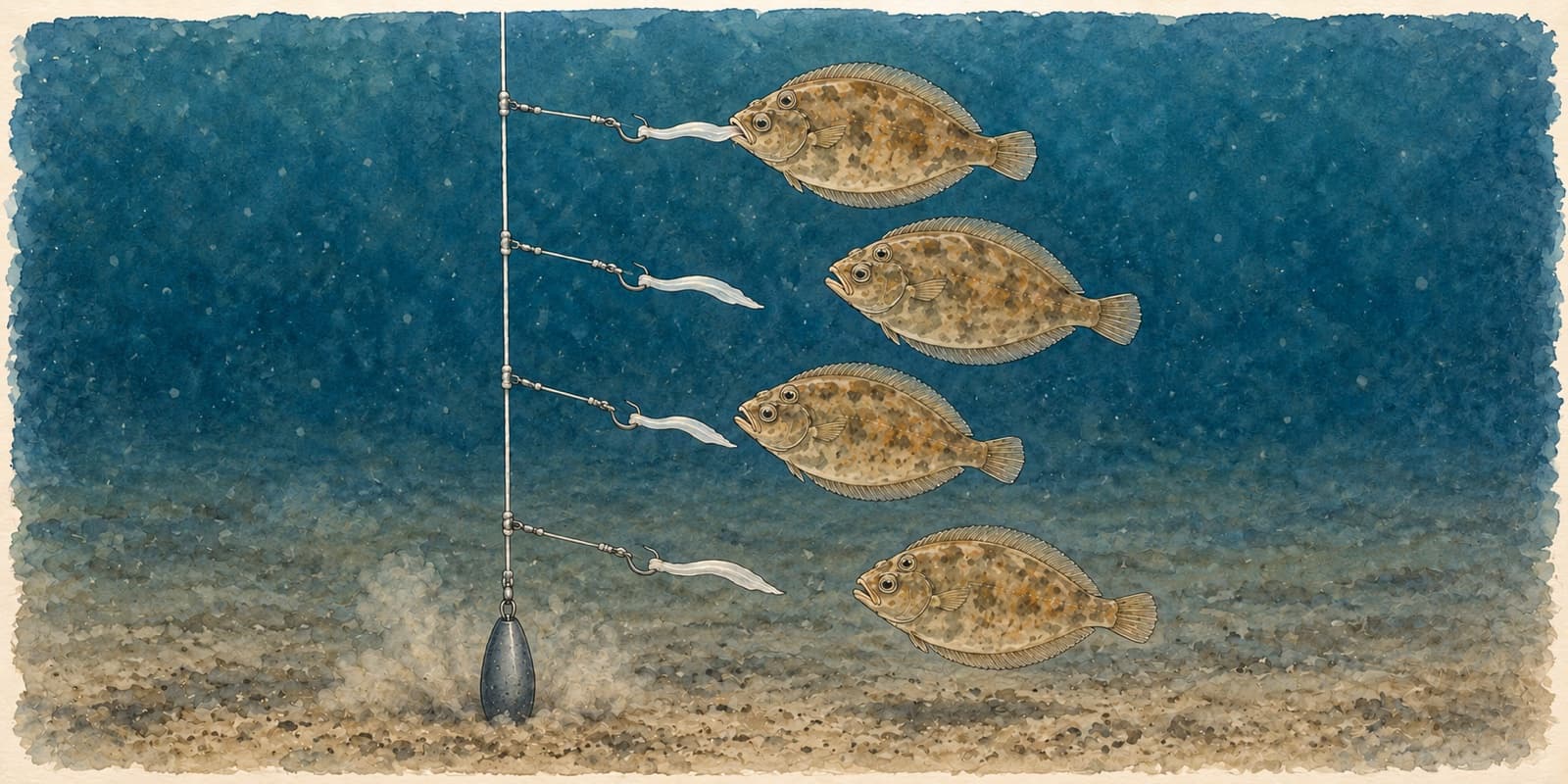
A sanddab rig is a light multi-hook leader with a sinker on the bottom.
- Hooks. Small, around size 6 or 8. A sanddab has a little mouth, and a big hook just gets its bait stolen.
- Leader. Most anglers fish a ready-made sanddab rig or a high-low leader with hooks spaced up the line. Hooks a few feet off the bottom still get bit, because sanddabs swarm up to the bait.
- Sinker. Enough to hold bottom on the drift. Five to eight ounces is typical in 200 to 300 feet. Go heavier with more wind or current.
- Rod, reel and line. A light to medium conventional outfit. Braid helps in deep water: it has little stretch, so you feel the bites and the bottom from 250 feet up. A rockfish outfit is more than enough.
Bait. Squid strips cut small and narrow are the standard because they stay on the hook through bite after bite. Anchovy, sardine, shrimp, mussel and clam all work, and so do small plastic grubs.
How to fish it
Drop to the bottom, come tight, and wait. The first bump is one fish. Do not reel. Give it a little longer and let the other hooks load up, then wind up steadily. Doubles and triples are normal on a good drift.
If nothing happens in a few minutes, you are on the wrong bottom or the wrong depth. Move. Sanddabs are rarely scattered thinly. When you find them, you usually find a lot of them, and when you lose them, drift back over the same mud.
The rules
Sanddabs are groundfish, but they do not follow the rockfish calendar. CDFW lists Pacific sanddab in the Southern region as open year round at all depths, which makes them a way to keep fishing when rockfish are closed or limited to shallower water.
Gear is another matter. Hook limits apply when you fish for rockfish and other groundfish, and anything closed that comes up on the same rig has to go back, so read the CDFW Southern region regulations before you fish a long multi-hook leader, and keep a descending device on board for any rockfish you have to release.
Cleaning and cooking
This is the real reason to catch them. Sanddabs are sweet, mild and delicate.
- Cleaning. Cut off the head and the belly cavity, rinse the fish, and leave the rest whole. The skin is thin and cooks nearly away, so there is no need to remove it. Wipe the slime off first.
- Cooking. Pan-fry them whole in hot oil, a short time per side, and eat the meat off the bone. Baking and grilling work too.
Two or three per person makes a good meal, so a couple of good drifts at the end of the day is often all you need.
Where Fish or Pass fits
The sanddab guide is a profile, and nothing on Fish or Pass grades sanddabs. The Bite Score does read conditions for rockfish, which often share the trip, and a calm day that suits a deep rockfish drift suits a sanddab drift too. Finding the right patch of mud is still up to you and the sounder.