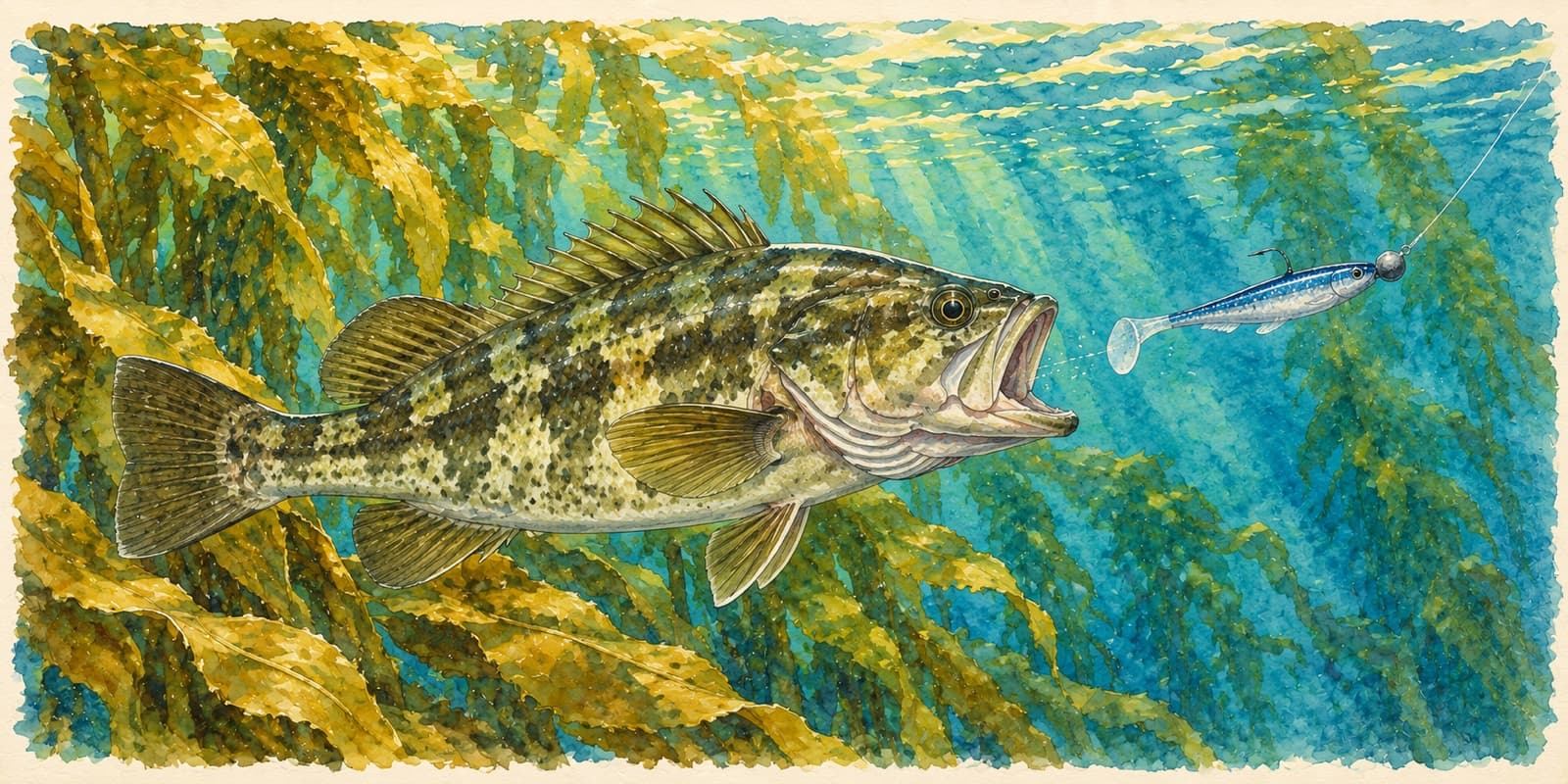
Ask a Southern California local how to catch a calico bass and there is a good chance the answer is a plastic. A soft paddle-tail swimbait on a leadhead, cast at the kelp and swum back, is the method a lot of people grew up on. It covers water, it picks the aggressive fish, and when it works it is hard to beat.
This is a plain-language guide to fishing swimbaits and plastics for calico bass: what weight to tie on, what size and color to throw, how to rig and retrieve around kelp, what rod and line to use, and when to put the plastic down and pick up a bait. For where calico live through the seasons, see calico bass in the kelp.
Leadhead weight: depth and current decide
The leadhead's job is to get the swimbait to the fish and keep it swimming at that depth. That depends on how deep the fish are holding and how hard the water is moving. It has little to do with the size of the fish.
As a rough guide, most anglers carry leadheads from about a quarter ounce up to an ounce, with a half to three quarters of an ounce the everyday choice.
-
Light heads swim higher and slower. They suit shallow kelp, the top of the canopy and slow, clean water.
-
Middle weights cover most sportboat days on the kelp edge and the breakwater.
-
Heavier heads get down to fish holding deep on the reef, keep contact in a strong current, and let you fish a wind-blown drift.
The test is simple. If you cannot feel the bait working, or your line is bowing far down-current, go heavier. If the bait drags bottom or snags kelp on every cast, go lighter or start your retrieve sooner. In winter, when the fish sit low, a heavier head that stays near the bottom tends to do better than a light one that rides over them.
Size and color
Size. A four- to five-inch paddle-tail is the standard calico plastic and matches the anchovies and small sardines the fish eat most of the season. Some big-fish specialists throw much larger swimbaits, seven inches and up, rigged weedless, to target grade fish. They get fewer bites and bigger ones. Start with the standard size until you know the water.
Tail. A paddle-tail, sometimes called a boot-tail, thumps and rolls on a steady retrieve. Curly-tail grubs and slimmer shad bodies have their days too, especially when the bait is small.
Color. Keep it simple and match the bait.
-
Anchovy and sardine tones, a dark back over a silver or white belly, are the base of most bags.
-
Natural greens and browns that look like the kelp fish calicos eat earn a spot in shallow, clear water.
-
Bright or dark colors help when the water is off-color.
When fish are biting, color matters less than placement and depth. When they are not, changing where and how you fish the bait usually beats changing its paint.
Rigging for the kelp edge
Two rigs cover nearly all calico plastic fishing.
The exposed leadhead. A swimbait threaded straight onto a leadhead with the hook point out. It hooks fish well and is the default on the outside edge of the kelp, along the breakwater, and over open reef where it will not drag through stalks on every cast. It is the everyday rig on the harbor breakwater out of Long Beach and the outside edge of the kelp off Point Loma.
The weedless rig. The hook is rigged so the point rests against or inside the plastic, usually on a weighted hook with a keeper. It comes through kelp and over rocks much more cleanly. Use it when you want to swim the bait through the canopy, into pockets, or across the boiler rocks. It trades a little hookup rate for far fewer snags.
Either way, rig the bait straight. A plastic pushed on crooked will spin, and a spinning bait does not get bit and twists your line. Swim it next to the boat before you cast and adjust it until it tracks true.
Where to cast and how to retrieve
The fish live in the structure, so the cast goes to the structure. Throw tight to the kelp edge, into the pockets and lanes inside the bed, or along the face of the rocks. A cast into open water ten yards off the kelp is a cast at nothing.
Pay attention to the current. Bait gets pushed onto the up-current edge of a kelp bed, and the calicos sit just inside it, facing into the flow. Casting so your bait swims along that edge, or with the current out of the kelp, looks natural.
Then think about speed.
-
Steady and medium is the starting point. Count the bait down to the depth you want and wind at a pace that keeps the tail thumping without the bait rising to the surface.
-
Faster when the fish are up and aggressive, in warm summer water and when bait is being pushed around on top.
-
Slow and low in cold water. Let the bait sink near the bottom and crawl it back with pauses. Winter fish will not chase.
Many bites come on the drop or in the first few cranks after the bait hits the water. Stay in contact from the moment it lands.
Rod, reel and line
You are fishing a lure into a forest and trying to pull a strong fish out of it. The tackle needs enough backbone to win that fight.
-
Rod. A seven- to eight-foot casting rod with a fast tip and a strong butt is the common choice. The tip lets you throw a light bait accurately, and the butt turns the fish.
-
Reel. A compact baitcaster or a mid-size spinning reel, with a smooth drag and a gear ratio fast enough to pick up line quickly.
-
Line. Most locals now fish braid as the main line. It is thin for its strength, casts well, and cuts through kelp instead of hanging up in it. Tie on a fluorocarbon leader of a few feet for abrasion resistance and a less visible connection to the bait. Go heavier on both near rough rock and thick kelp. Some anglers in very heavy kelp tie straight to the braid for its cutting edge.
When a calico eats, do not swing hard and stop. Point the rod at the fish, keep winding and lean back. Then pull the fish up and away from the structure before it can get its head down. A fish that reaches the kelp often wraps you and pulls free.
When bait beats plastic
Plastics are not always the answer. Live bait wins on more days than plastic purists like to admit.
-
On a slow bite. A lively anchovy or sardine swimming on its own draws fish that will not chase a lure.
-
For newer anglers. Fly-lining bait is easier than casting accurately and keeping a swimbait at the right depth.
-
In cold or dirty water. Smell, natural movement and a slower presentation all count more when fish are sluggish or cannot see well.
-
When the boat is chumming. Once a sportboat starts throwing bait, the calicos key on it. A plastic still works, but bait is what they are watching.
Plastics win when the fish are aggressive, when you want to cover a lot of kelp edge, and when you want to pick bigger fish out of a school of small ones. The iron has its place too. A small surface jig along the kelp line catches calicos when they are up and feeding, and the guide to picking surface and yo-yo jigs covers how it works.
Where Fish or Pass fits
Fish or Pass gives calico bass a daily Bite Score for each port's grounds. It weighs water temperature, bait in the area, kelp and reef structure, recent landing reports and sea conditions, and turns them into a call of Catching, Fishing or Pass. You can read how it is built on how it works.
It cannot choose your leadhead or make a calico eat your swimbait. It tells you whether the conditions favor going, and the tackle is up to you. Before you keep a fish, check the current CDFW ocean sport fishing regulations.