White seabass have a reputation for being impossible to pattern. Most of that reputation comes from fishing them by the calendar. Fish them by the squid instead and they start to make sense. When market squid pile onto a sand bottom to spawn, white seabass come to eat them, and the best seabass fishing in Southern California happens on and around those spawning grounds.
This post is about that link: what the squid are doing, where they do it, when the seabass show up, and what it means for how you fish a night. For the fish itself, start with the white seabass species guide.
Why the squid move the seabass
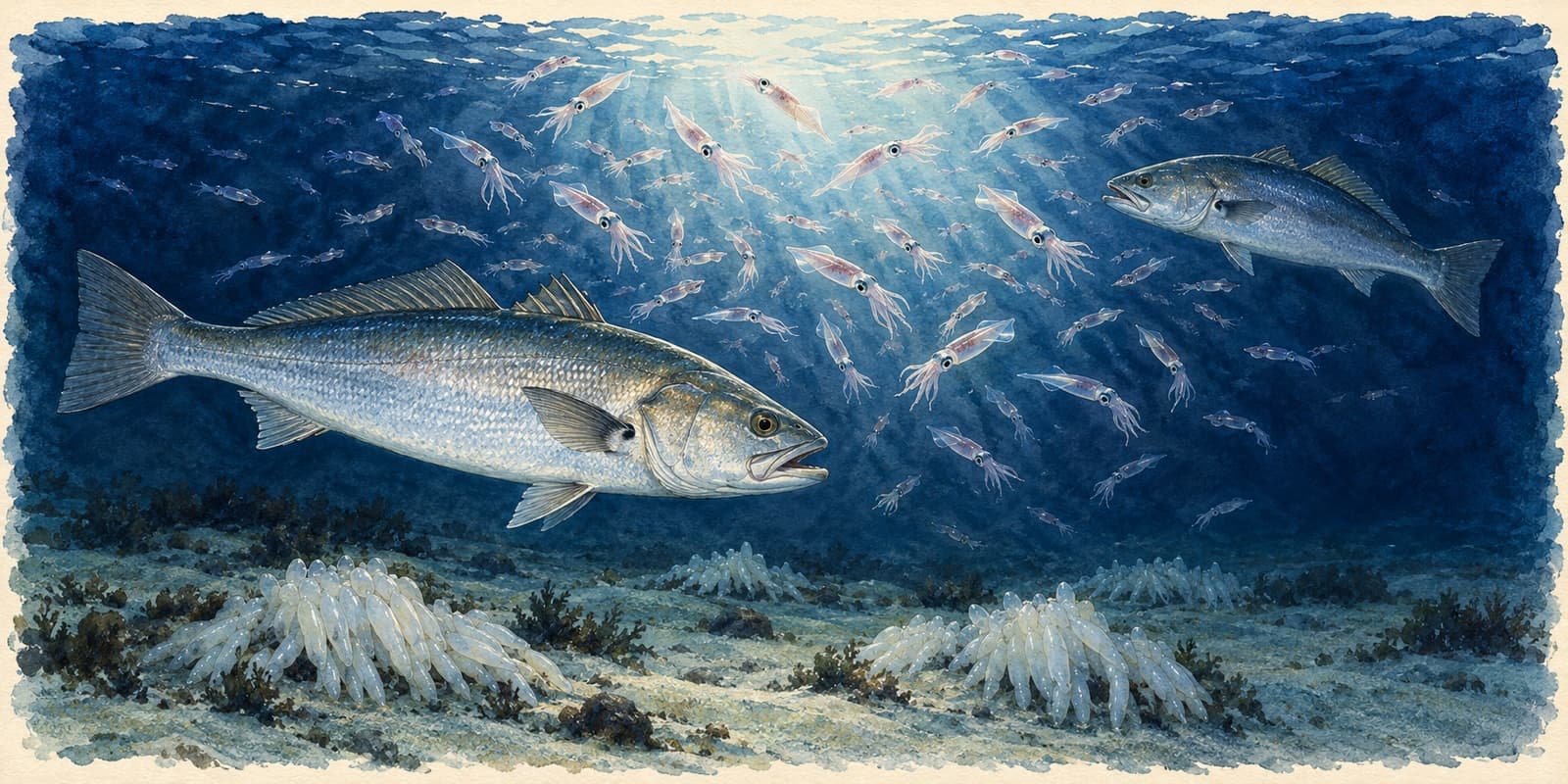
Market squid live fast. NOAA puts their life span at six to nine months, and they die shortly after they spawn. When they are ready, they gather in huge numbers over sand, mostly at night, and the females lay clusters of egg cases that build into mounds on the bottom. Off Southern California, NOAA says that spawning runs from about October through April or May.
To a white seabass, a spawning aggregation is a buffet with a schedule. The fish eat plenty of other things through the year: anchovy, sardine, Pacific and jack mackerel, and pelagic red crabs when they show up. But squid on a spawning ground are dense, slow and easy, and spent squid drifting dead or dying near the bottom are easier still.
That is why the bite so often comes in a window. Seabass can sit near the squid for hours without eating much, then switch on at grey light or on a change of tide and feed hard for twenty minutes.
When: the squid set the calendar
The species guide calls March through June the best months, and that lines up with two things happening at once. The squid are still spawning on the island grounds, and the seabass are coming inshore for their own spawn, which runs from about March into September and peaks in late spring and early summer.
Water in the high 50s to mid 60s suits both. In years when squid hold on the island grounds into summer, the seabass often stay with them. In years when the squid are scarce, the spring bite is thin no matter what the calendar says. Warm El Niño years have been hard on squid, and seabass fishing tends to follow.
CDFW cuts the white seabass bag south of Point Conception through part of the spring, exactly when the squid bite is best. Check the CDFW Southern region regulations before every trip, and measure every fish. A rat under the legal size goes back.
Where: the squid grounds
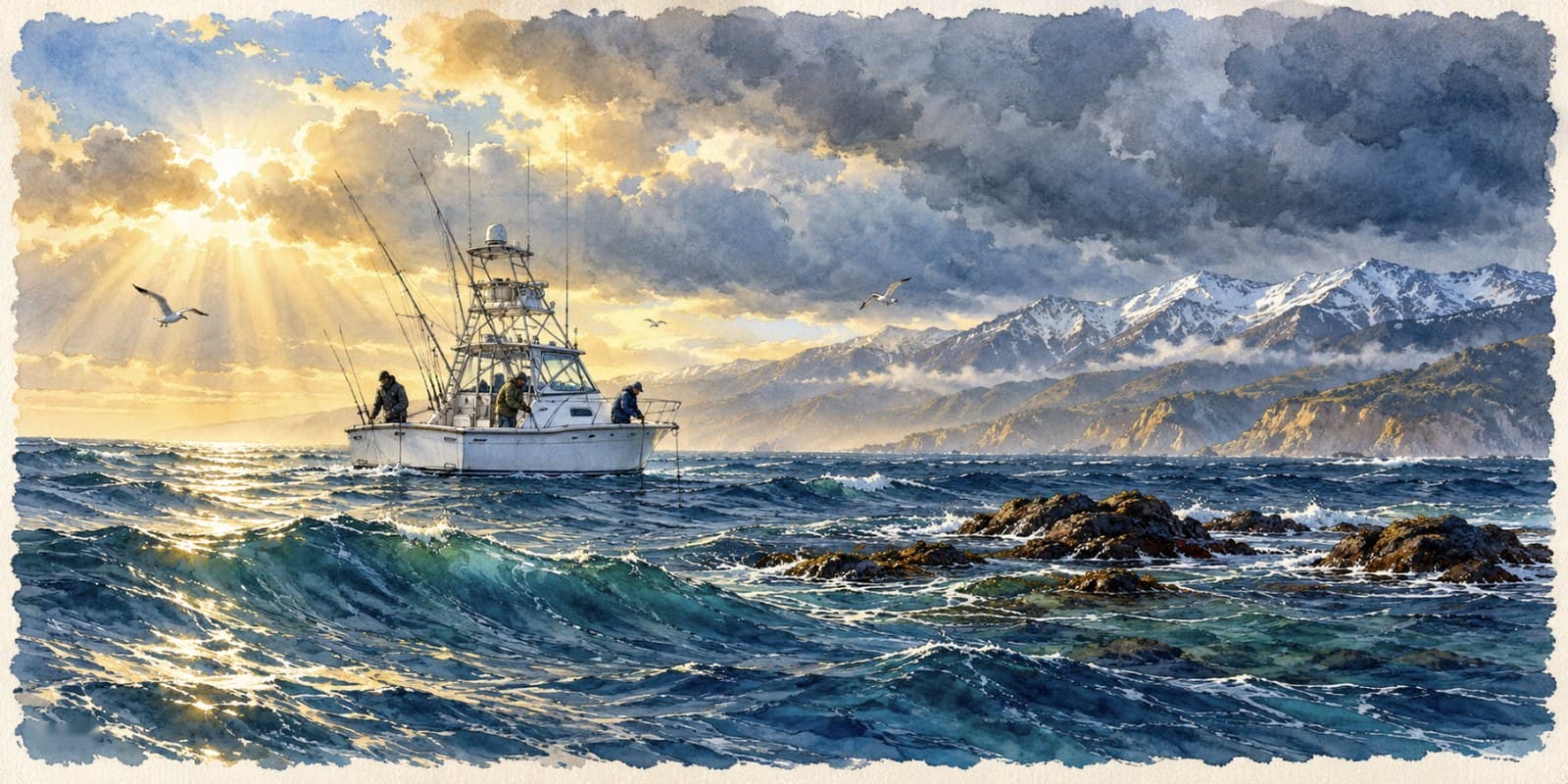
Squid spawn on sand or mud, typically in about 90 to 120 feet of water, and they tend to come back to the same patch of bottom night after night. Traditional island grounds include:
- Santa Rosa Island: Becher's Bay.
- Santa Cruz Island: Chinese Harbor.
- Santa Barbara Island: the front side.
- Catalina: the Palisades.
- San Clemente Island: Pyramid Cove, where Navy closures apply.
Squid also spawn along the coast. La Jolla Shores, the sand off Redondo and the Malibu coast have all held spawning squid, and the commercial light boats working a stretch of coast at night are the clearest sign that squid are there.
Three ways to find a ground when you get there:
- Light boats. Commercial squid boats light up the water at night. Fish near them, not on top of them, and give them room.
- Egg beds on the sounder. Fresh egg mounds show as a pale fuzz on the bottom over sand.
- Squid at your own light. If squid rise to a light hung over the side, you are on them.
Plenty of island sand sits inside marine protected areas. Check the CDFW MPA maps before you drop anchor.
Night, grey light and the kelp
A squid night has three phases, and the seabass behave differently in each.
After dark. Squid gather under the light and the seabass cruise just outside it, picking off strays. They feed high in the water at night as well as near the bottom, and they rarely come close to the boat, so baits fished away from the hull and outside the glow get bit.
Grey light. This is the window people lose sleep for. Spent squid are dropping to the bottom and the fish feed on them there. A bait a few feet off the sand is in the right place.
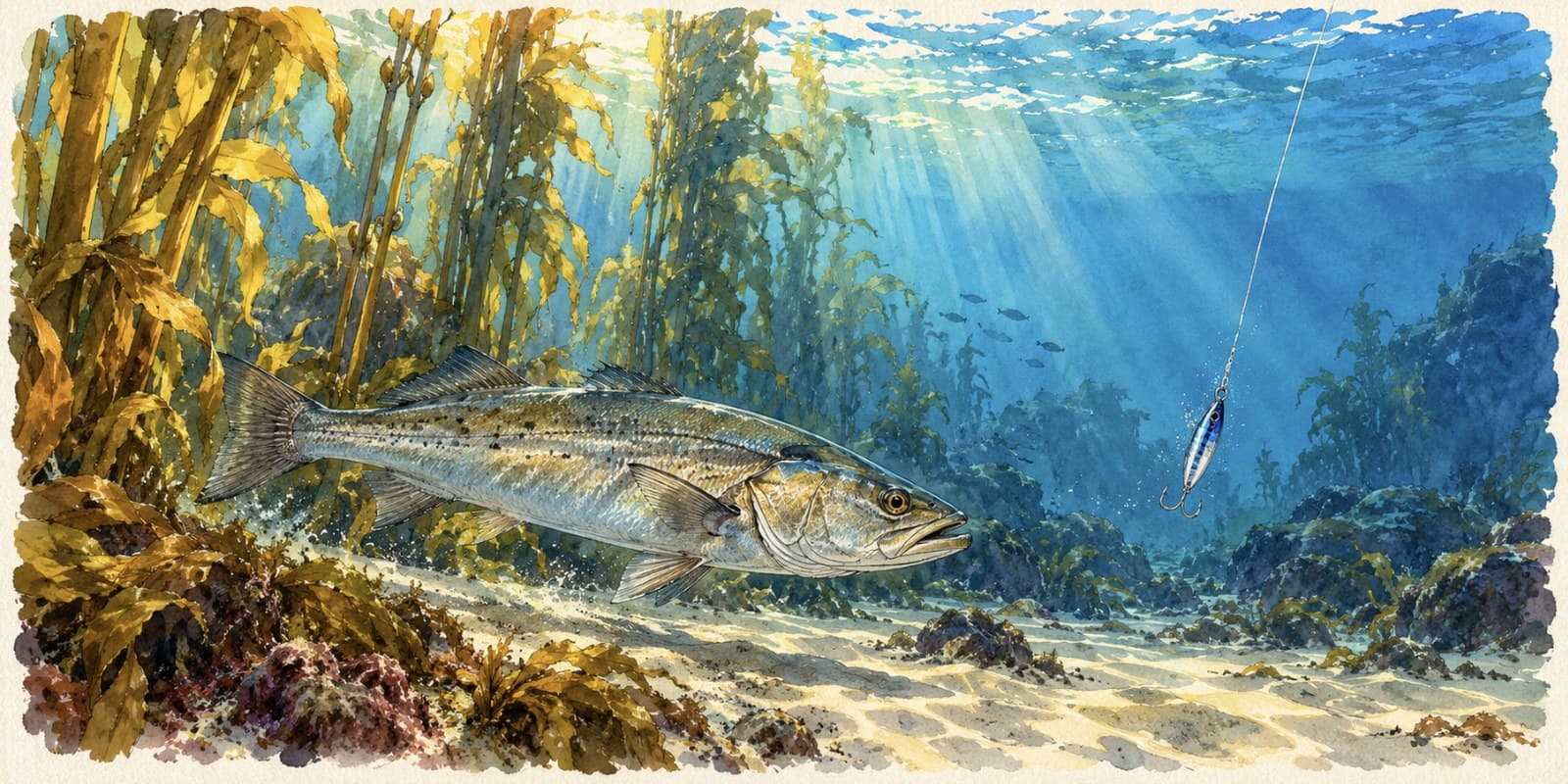
Daytime. The fish slide back into the shade of the kelp. They are more likely to come out on a day with current, which tends to be strongest around the new and full moons, and along a milky colour break at the kelp edge.
Rigging a live squid
Three rigs cover a squid night, and most boats fish all three at once.
- Dropper loop. A large hook on a loop a few feet above a torpedo sinker, sitting just off the bottom. Pin the squid through the tip of the mantle so it stays lively. This is the grey-light rig.
- Fly-lined squid. A squid on a hook with no weight or a small sliding egg sinker, let out away from the boat and outside the light. This is the night rig.
- Leadhead or jig. A squid pinned to a single hook on a jig or leadhead, worked between the light and the bottom.
Use line heavy enough to pull a big fish away from kelp: 40 pound monofilament at minimum, or braid with a fluorocarbon leader of about that strength. If a fish wraps the kelp, ease off the pressure and let it swim out, then come tight again.
No squid? A big live mackerel is the next best bait for a seabass on the kelp line. Making mackerel on a sabiki covers how to catch them and keep them alive. Frozen squid also catches fish when that is all you have. With no bait at all, jigs, swimbaits and spoons for daytime white seabass can still get bit on the kelp line.
Making squid or buying it
In seasons when squid are around, some bait barges sell it live by the scoop, and bait boats sell it at the islands. Ask at the landing before you leave. Out of Channel Islands Harbor, Marina del Rey, Long Beach and Newport, the barge is the first call.
To make your own, hang a light over the side, let the squid rise to it, and scoop them with a long-handled, fine-mesh dip net or a crowder. Lighted squid jigs work when they hold deeper. Keep the light on after you bait up. The rules for taking squid recreationally are in the CDFW ocean regulations.
A fish worth getting right
White seabass are the largest croaker on this coast, and they are slow growing and long lived, which is why the rules run tight. They are also one of the few fish in the Bight with a hatchery behind them. CDFW's Ocean Resources Enhancement and Hatchery Program raises juveniles at a Carlsbad hatchery run by Hubbs-SeaWorld Research Institute, volunteers grow them out in pens at harbours across Southern California, and the program passed three million tagged fish released in April 2026.
Know which fish you have before you swing it aboard. A huge, dark, heavy-bodied fish that eats your squid on the bottom may be a giant sea bass, which cannot be kept. The giant sea bass recovery story explains why.
Where Fish or Pass fits
The white seabass guide is a profile of the fish, not a daily grade. The Bite Score reads conditions for the graded species, and on a spring island trip the one to watch is yellowtail, which works the same kelp and current. Neither can tell you whether the squid spawned last night. The light boats and your sounder can.