Spotted bay bass are the reason a lot of Southern California anglers own a light spinning rod. They live inside the bays all year, they eat in water you can wade or paddle, and they do not need a boat ride, a bait tank or a calm day offshore. When the open ocean is blown out, the bays usually still fish.
This is a plain guide to the tackle and technique for spotties: the rod and line, the baits, where they hold, how the tide moves them, and how to release them well. For the fish itself, start with the spotted bay bass species guide.
Where the fish live
CDFW's status report puts most of the sampled catch in five places: San Diego Bay, Mission Bay, Newport Bay, Anaheim Bay and the Los Angeles and Long Beach harbors. They are uncommon north of Santa Monica Bay. Inside those bays they want warm, shallow water with sand or mud bottom, eelgrass and some rock relief.
A few patterns hold across all of them:
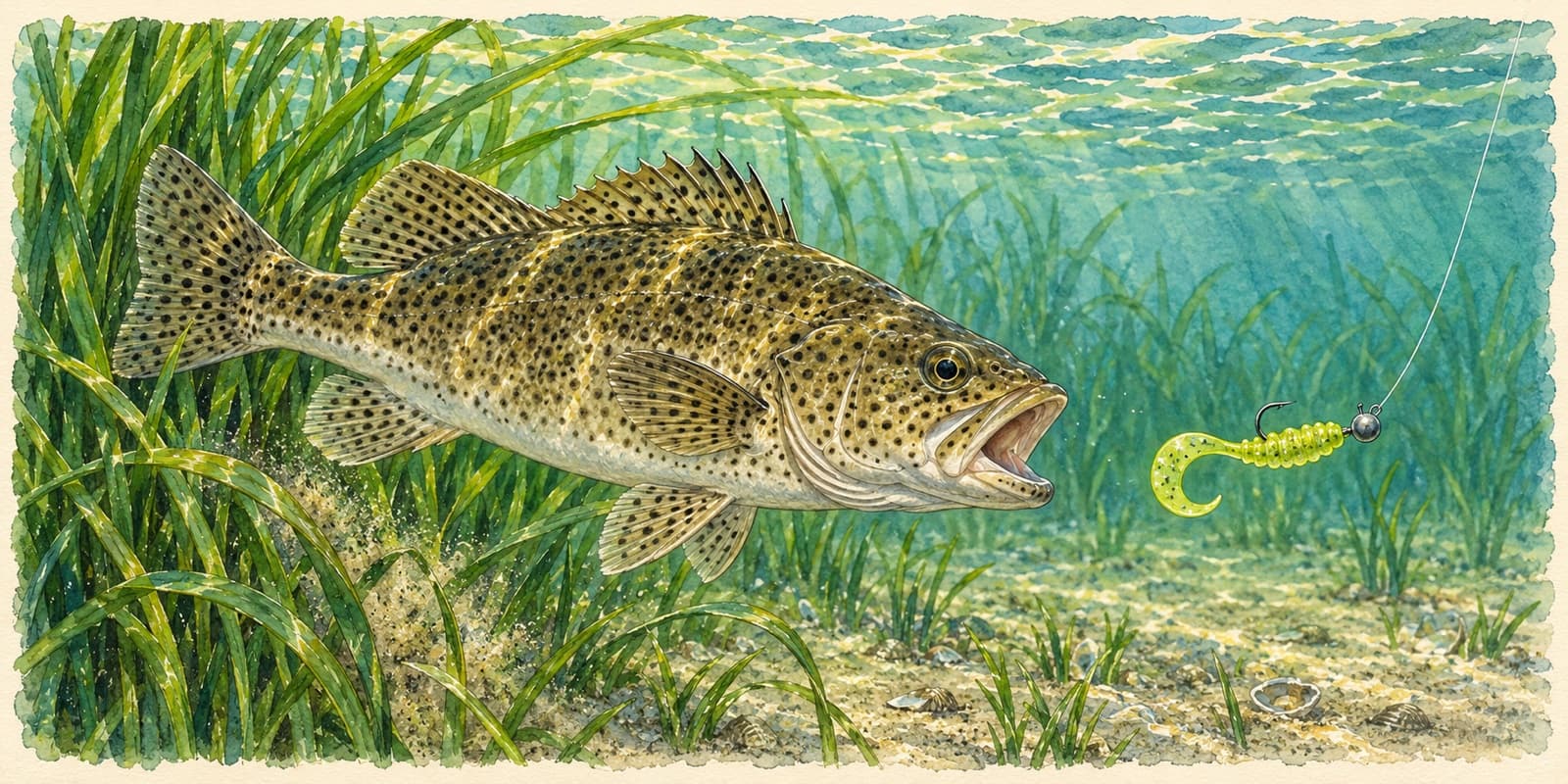
- Eelgrass edges. Fish hold in and along the grass beds and ambush what comes off them. A depth finder that shows the beds is worth having.
- Hard structure. Riprap, dock pilings, bridge footings, channel markers and rock piles. In San Diego Bay, the water on both sides of the Coronado Bridge is a well-known area.
- Drop-offs. The edge where a flat falls into a channel concentrates fish, especially on a moving tide.
- Depth. Most of the fish are shallow. San Diego Bay anglers often find the best numbers in roughly 6 to 15 feet, and most of Mission Bay is only 10 to 12 feet deep.
Out of San Diego, the bay is right on the doorstep of the Point Loma landings. Up the coast, Newport Bay sits inside the harbor described in our Newport Beach guide, and the Long Beach harbor water is covered in fishing out of Long Beach. Parts of several bays are marine protected areas or restricted zones. Check the CDFW MPA maps before you fish a new stretch.
Rod, reel and line
This is light-tackle fishing, and the fun of it depends on keeping it light.
- Rod. A light spinning or casting rod in the 6.5 to 7.5 foot range. Enough tip to cast a quarter-ounce head a long way, enough backbone to turn a fish away from a piling.
- Reel. A small spinning reel or a light baitcaster. Drag matters more than line capacity. You will never get spooled.
- Line. Braid for casting distance and feel, with a fluorocarbon leader of a few feet. The leader takes the abrasion from riprap, shell and pilings and is less visible in the clear water over the grass.
Baits that work
Spotties eat mostly crabs and clams, with ghost shrimp, pipefish, gobies and anchovies on the menu too. Small baits that look like that food catch them.
- Swimbaits and grubs on a jighead. The standard. A 3 to 3.5 inch paddle-tail or curl-tail grub on a quarter-ounce head covers most of the bay. Go to an eighth of an ounce over shallow grass, heavier in a channel with current. Cast to the structure, let it fall, and hop or slow-roll it back near the bottom.
- Drop shot. A small grub, around 2.5 inches, on a drop shot holds a bait just off the bottom in one spot. When fish are nipping and missing, a smaller bait often gets them all the way on.
- Crab and shrimp imitations. Small creature baits and shrimp-shaped plastics, crawled along the bottom near clam beds and grass.
- Jerkbaits over the weeds. At higher tides, a soft jerkbait twitched over the top of thick grass, or a silver and black hard jerkbait that looks like an anchovy. Halibut and corvina eat these too in Mission Bay.
- Floating crankbaits and spinnerbaits. A floating crankbait rises erratically on the pause, which is what you want over grass. A small spinnerbait run just over the weeds covers water fast.
Chartreuse is a long-standing favorite color in Mission Bay. Plenty of other colors catch fish, so match the clarity of the water: brighter or darker colors in murky water, natural shades in clear.
Many of the swimbait rules in our calico bass swimbait and plastics guide carry straight over, scaled down. The heads are lighter and the baits are smaller, but the idea of matching weight to depth and keeping the bait near the bottom is the same.
Moving water is everything
The most repeated advice from bay anglers is the simplest: fish the moving tide. As long as water is moving, fish are positioned and feeding. At slack, the bite often dies.
- Plan around the tide chart, not the clock. A rising or falling tide in the middle of the day beats a slack tide at dawn.
- Fish the current side of structure. Spotties sit where a piling, a point or a grass edge breaks the flow, facing into it.
- Change depth with the tide. At high tide fish move up onto the flats and the grass. As it drops, they slide back to the edges and channels.
When to go
Spotties are a year-round fish, and that is a large part of their appeal. The catch does peak in summer. CDFW's figures put about 60 percent of recreational landings in June, July and August, which is also when the fish spawn, gathering near the mouths of the bays and harbors. One long-term study found more young fish settling in years with warmer summer water, though CDFW notes other work has been less clear.
Winter is quieter but rarely empty. When nothing offshore is working, a bay with moving water is still worth a few hours.
Catch and release, and identification
This is a catch-and-release fishery in practice. CDFW estimates that about 96 percent of spotted bay bass caught in southern California from 2004 to 2019 were released. Many anglers fish bay bass tournaments that score by length, not weight, and the fish go back.
To release well:
- Use single hooks or crush barbs where you can.
- Lip the fish with a thumb in its mouth and support its body. Do not hang a big one vertically by the jaw.
- Keep it wet and brief. A quick measure and a photo, then back in.
The bays also hold young calico and barred sand bass, and all three share one combined bag limit, with a separate sub-limit on sand bass. A spotty is covered in dark spots. A barred sand bass has dark vertical bars along its sides, and a calico is mottled with pale blotches. Check the CDFW ocean fishing regulations for the current limits. The juvenile sand bass you catch in the bays are the fish that will one day join the summer schools on the flats, covered in our post on barred sand bass and the summer spawn.
If you plan to eat fish from a bay, read the state's advice first. The Office of Environmental Health Hazard Assessment publishes site-specific eating guidance for San Diego Bay that includes spotted sand bass, and other advisories for the coast on its fish advisories page.
Where Fish or Pass fits
The spotted bay bass guide is a profile of the fish. The Bite Score does not grade bay bass. It grades the calico in the kelp outside the bays, reading water temperature, sea conditions and recent reports each day as Catching, Fishing or Pass. On a day when the ocean side reads Pass because of wind and swell, the bays are often the place to go. The score cannot read the tide in a back bay for you, and it cannot make a spotty bite.