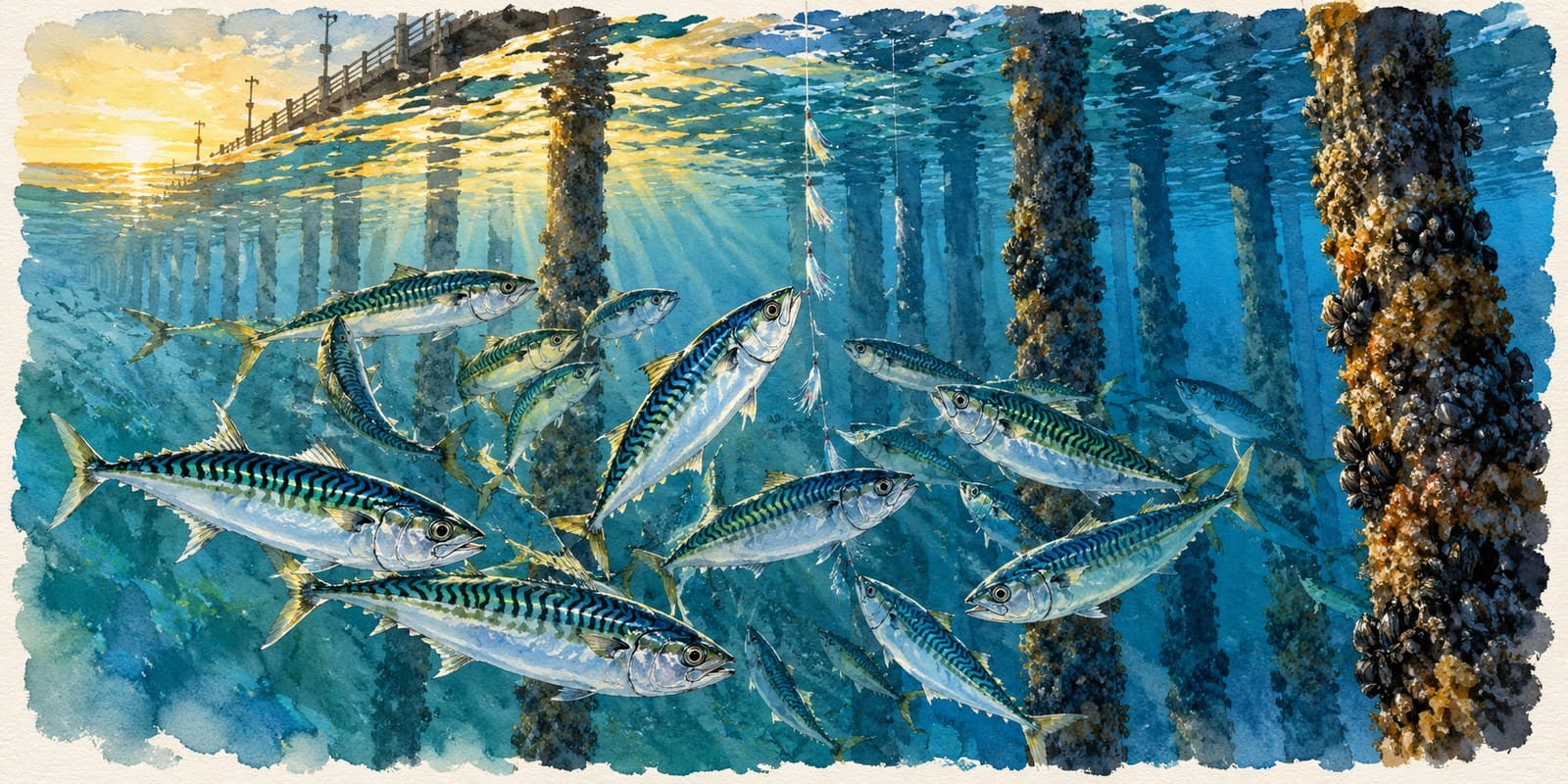
Half of a serious Southern California trip is getting bait, and getting bait usually means mackerel. A lively greenback is the bait for yellowtail, white seabass, halibut and bluefin, and the bait barge does not always have them. So the first grey hour of a lot of trips is spent with a sabiki in the water, trying to fill the tank before the fish you came for wake up.
This is a plain guide to doing that well: what you are catching, where to find it, how to fish a sabiki without turning it into a bird's nest, and how to keep the bait alive once it is in the tank. For the fish itself, see the Pacific mackerel species guide.
Know what is coming up
A sabiki drop into a bait school can bring up several things, and they are not all the same bait.
- Pacific mackerel. The greenback. A dark blue-green back crossed by about thirty dark, wavy lines, a silvery belly, and a row of small finlets behind the second dorsal fin. This is the one you want for most big fish.
- Jack mackerel. Called Spanish mackerel on the boats, though it is not a true mackerel at all but a member of the jack family. Look for a line of hard, bony scales along the whole lateral line, which dips sharply partway along the side, and a black spot at the top edge of the gill cover. Jack mackerel are good bait too.
- Sardines, anchovies and topsmelt. Smaller baits that come up on the same rig. Sardines and anchovies are the standard bait-barge offering, and a few on the side are useful for halibut and calico.
Mackerel often school with jack mackerel, sardines and bonito, so expect a mix.
Where and when to find them
Mackerel are everywhere in the Bight and around all year: harbour mouths, jetties, piers, the kelp line, the open ocean, and under lights at night. The trick is finding them close enough to the surface to reach easily. If you are fishing from shore rather than a boat, our guide to pier mackerel fishing in Southern California covers the rail side of it.
- Low light. They sit deeper in bright sun and come up at first and last light, which is when you want to be filling the tank anyway.
- Marks on the sounder. A tight ball of bait off the bottom near a harbour entrance or along the kelp is worth a drop. Stop on the mark and fish straight down.
- Night. Mackerel come up to feed in the dark and gather under lights, which is why boats that leave at night often make bait on the way out.
The species guide gives 60 to 70 degrees as the water they like. In cold water they can be harder to find and you may be fishing deeper.
The sabiki
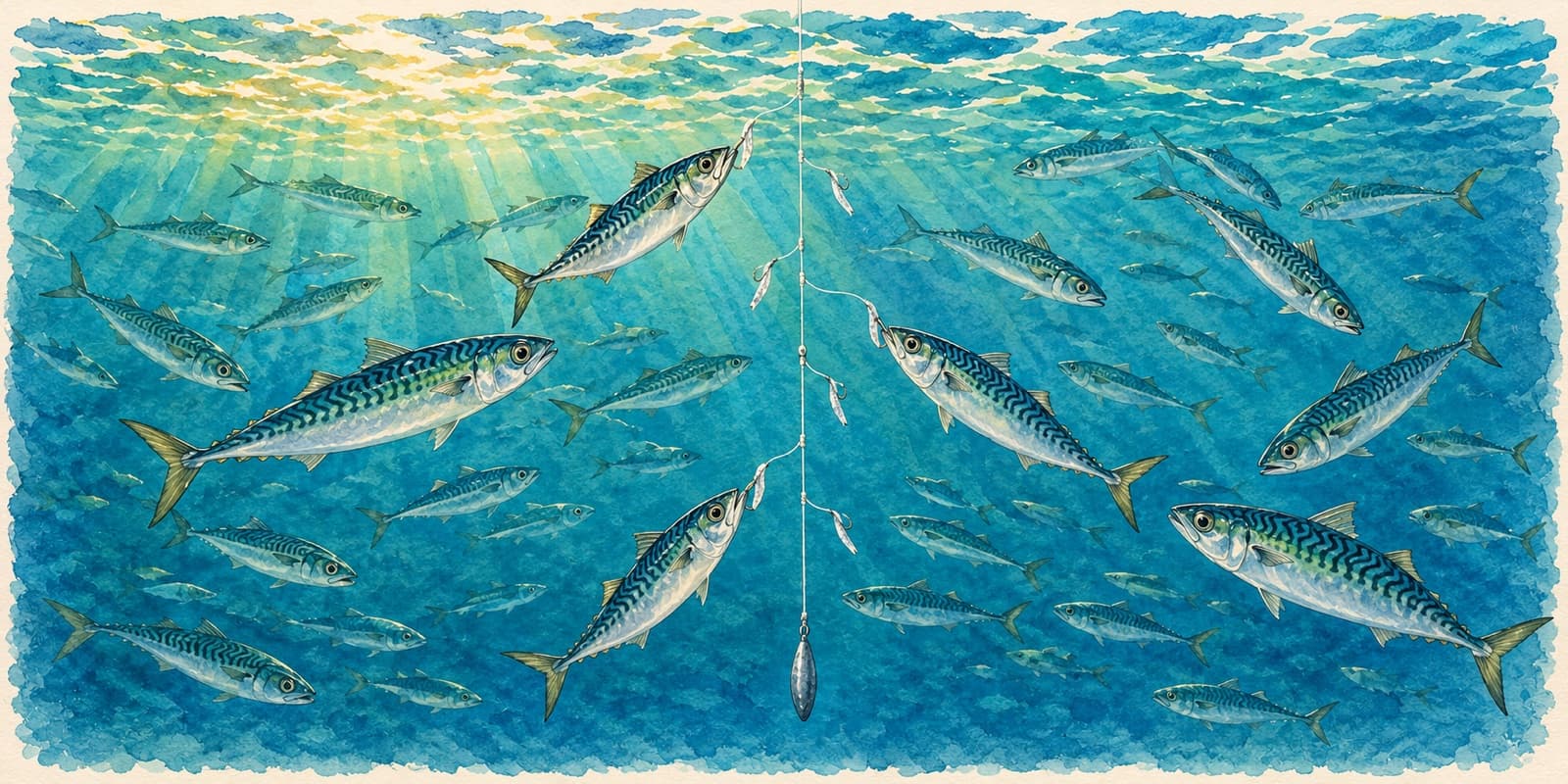
A sabiki is a string of small hooks, each dressed with a bit of fish skin or flash, tied on short branch lines off a main leader, with a snap at the bottom for a sinker. Most are a little over six feet long.
Hook size. Size 6 is a good all-round choice for mackerel. Go up toward size 2 when you want only the big greenbacks, for white seabass or bluefin, and down toward size 8 or 10 for sardines and anchovies.
Line strength. Thicker line tangles less and untangles more easily, and it stands up to a bonito grabbing one of the hooks. A sabiki with a main line around 30 pound and branch lines around 20 pound is a sensible place to start.
Sinker. Start light, two or three ounces. If you are loading every hook on every drop, go much heavier. The rig drops faster and the fish cannot swim it into a knot on the way down.
Rod. A long rod, seven and a half to eight feet, makes the rig far easier to handle. You can lift the whole thing clear of the water and swing it over the tank without the top hook jamming in the tip guide. Some anglers use a hollow sabiki stick that stores the rig inside the rod. Air it out after the trip so the hooks do not rust.
Fishing it
Drop to the mark and work the rig with gentle lifts of a foot or two. Mackerel bites are quick taps. Do not jerk. Lift steadily and let them hang on.
When one fish is on, leave the rig in the water a few seconds longer and let more hooks load up. Then keep the drag tight and wind them up without stopping. A slow fight gives the fish time to wrap the rig around itself and the next angler's line.
A few habits keep you fishing instead of untangling:
- One sabiki per side of a small boat. Two on the same side tangle.
- Lift the rig straight up over the tank and lower the fish into the water before unhooking.
- Never leave a sabiki dangling loose on deck or in the rod holder. Seven hooks in the wind find everything.
Sabikis carry more hooks than the groundfish rules allow, so if rockfish or other groundfish come up, release them and check the CDFW ocean regulations before you fish a sabiki near the bottom.
Into the tank alive
A mackerel that gets bruised, squeezed or dropped is a dead bait within the hour. How you get it off the hook matters more than how you caught it.
- Do not touch them if you can help it. Hold the rig over the tank and shake the fish off, or use a bait release that pops the hook out without a hand on the fish.
- Be quick and gentle when you do have to handle one, and never squeeze.
- Circulating water. Fresh seawater flowing through the tank, not a still bucket.
- Do not overcrowd. A dozen lively greenbacks fish better than forty half-dead ones.
- Use a bait net to pick out the size you want, rather than chasing fish around the tank by hand.
Rinse the sabiki in fresh water at the end of the day and it will last more than one trip.
Putting it on the hook
A greenback fly-lined on a hook with no weight is the classic Southern California live bait.
- Through the nose or upper jaw for a bait that swims naturally near the surface. This is the default.
- Through the collar, behind the gill plate, for a bait you want to stay on the hook through long casts or that will be slow-trolled.
- Through the back near the tail to make the bait swim away and down from the boat.
The same bait goes down on a dropper loop or sliding sinker for white seabass and halibut. When the squid are spawning, seabass may want squid instead; the white seabass and squid spawn post covers that. And when the tank is full, swap the sabiki for a surface jig. The iron covers which jigs get bit.
Who else wants your bait
Mackerel schools draw predators, and you will often see the fish you are after crashing the same bait you are trying to catch. Barracuda and bonito both feed on mackerel and anchovies and often show up in the same water. Pacific barracuda in Southern California and the history of bonito in Southern California cover those two fish.
Mackerel are worth eating too. They are oily and strong and very good grilled fresh, the day they are caught.
Where Fish or Pass fits
The mackerel guide is a profile, not a daily grade. The Bite Score reads conditions for the fish your bait is for, such as yellowtail and bluefin. It cannot tell you where the bait is this morning or fill your tank. That part is still the sabiki and the sounder.