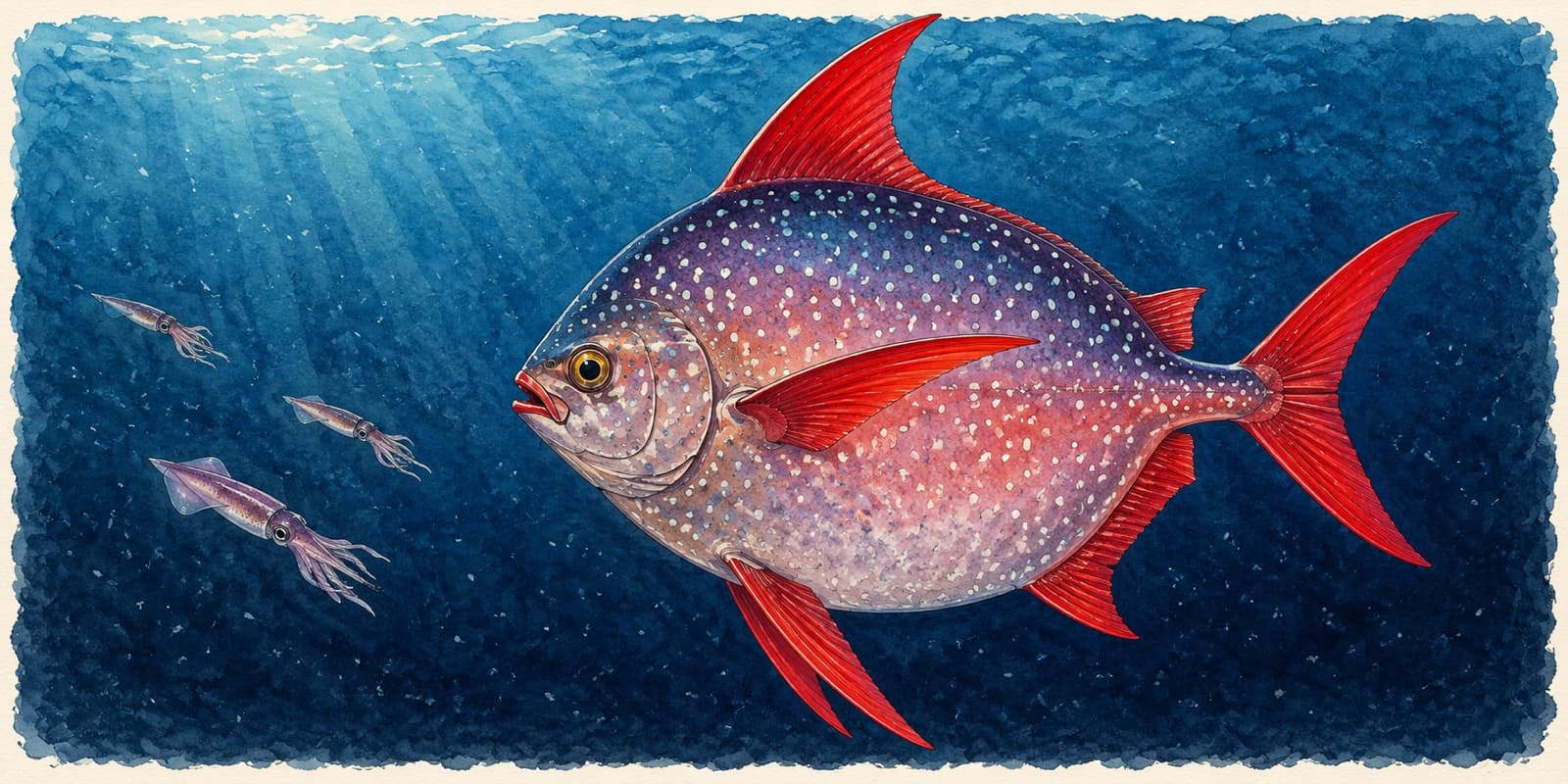
Every so often a fish comes over the rail of a Southern California boat that stops the deck cold. It is round, as tall as it is long, silver and rose with white spots, with fins the color of a fire engine. That is an opah, also called a moonfish, and for most anglers it is a once-in-a-career fish.
It is also a fish with a genuine scientific claim to fame, discovered by researchers in La Jolla. This post covers what makes the opah unusual, where it lives in the Bight, and how the few that get caught here end up on a hook.
What an opah is
An opah is built like a dinner plate stood on edge: deep, round and flattened side to side. The back is steel blue to violet, shading to rosy silver on the sides, the whole body is sprinkled with small white spots, and every fin is scarlet. The mouth is small and the eye is large. The opah species guide puts a typical fish at 60 to 150 pounds.
The way it swims is the first clue that something is different. Most fish drive themselves with the tail. An opah flaps its long red pectoral fins, more like a bird's wings than a fish's fins, and keeps them going constantly. It is a solitary fish, not a schooling one.
The first warm-blooded fish
In May 2015, a team led by Nicholas Wegner at NOAA Fisheries' Southwest Fisheries Science Center in La Jolla published a paper in the journal Science showing that the opah keeps its whole body warmer than the water around it (NOAA Fisheries). It was the first fish found to do that. The clue came from a gill sample collected by biologist Owyn Snodgrass.
Here is how it works, in plain terms:
- The fins make the heat. All that constant flapping of the pectoral fins generates warmth in the muscle.
- The gills keep it. Gills are where a fish loses most of its heat, because warm blood meets cold water there. In the opah, vessels carrying warm blood out to the gills wrap around vessels carrying cold blood back, so the returning blood is warmed before it reaches the body. NOAA compares it to a car radiator.
- Fat insulates the core. A layer of fatty tissue surrounds the gills, heart and swimming muscle and helps hold the heat in.
The result was muscle that averaged about 9°F (5°C) warmer than the surrounding water while the fish swam between 150 and 1,000 feet down, and body temperatures that held steady even when the water temperature dropped sharply.
Tuna and some sharks, makos among them, warm parts of their bodies, such as swimming muscle, eyes and brain. Swordfish warm the brain and eyes. The opah warms its heart and the rest of it too. It is not warm-blooded the way a mammal is, holding one fixed temperature, but it is warmer through and through than any other fish known.
Why it matters is speed. A cold fish in cold water has a slow heart and slow reactions. The warm opah stays quick and sharp-eyed in deep, cold water, which makes it an active predator of fast prey like squid rather than the sluggish drifter it was once taken for.
Where they live in the Bight
Opah live deep and offshore. Satellite tracking by NOAA showed tagged fish spending most of their time between about 150 and 1,300 feet down, without coming regularly to the surface. That is the cold water below the thermocline, around the deep layer of squid, small fish and krill that rises toward the surface at night and sinks by day.
That depth is why almost nobody sees one. It is also why the numbers are hard to read. In 2012, NOAA researchers said opah had begun showing up regularly in federal research trawls in the region after being absent from them for 10 to 15 years. In 2015, NOAA noted that its research surveys off California had been catching more opah in recent years, and that the reason was not clear. Anglers saw the same thing: 2012 brought more opah to Southern California boats than many veteran offshore anglers could remember.
How they get caught here
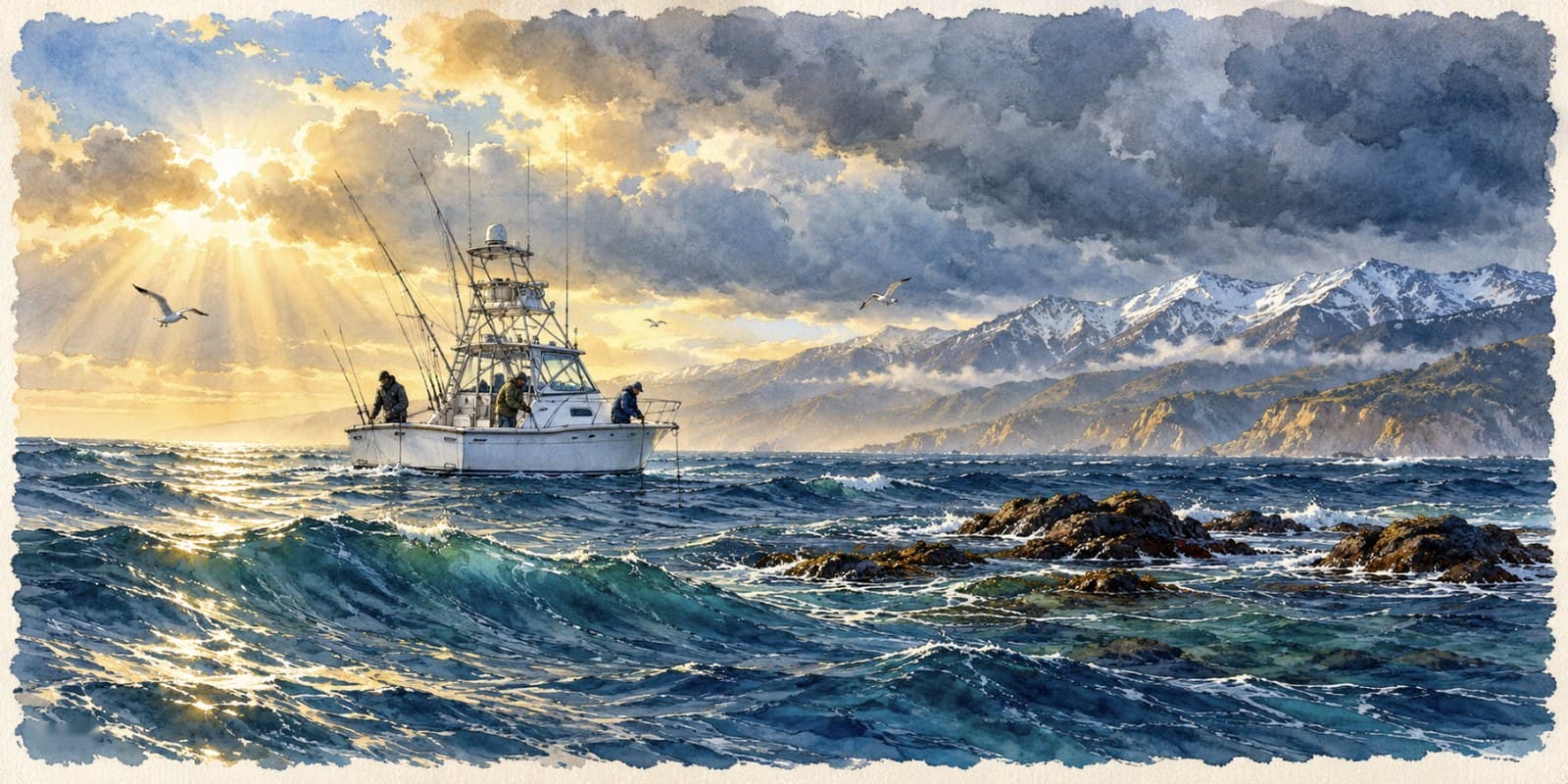
Nobody in Southern California sets out to catch an opah. They come as a surprise to anglers fishing for something else, and the surprises have a pattern.
- On offshore tuna trips, fished deep. San Diego fleet reports describe opah turning up alongside albacore and bluefin, usually hooked well below the surface. A 2007 report from the fleet noted that opah take both bait and jigs and that most are caught early in the morning or near sunset. Heavy iron worked deep is a classic way they get hooked, so the yo-yo jig fishing that the tuna crowd already does is the right technique. The albacore connection runs through the fishery's history too, which our post on albacore in Southern California tells.
- On deep gear. Anglers fishing deep for swordfish are working the same cold water the opah lives in. Our guide to deep-drop swordfish in Southern California covers that rig.
- Once in a while, somewhere strange. In May 2012, a private boat trolling for thresher sharks about two miles off Newport Beach, in roughly 100 feet of water, hooked a 140-pound opah on a skirted trolling lure with a mackerel under the skirt. It was weighed at the Balboa Angling Club the next morning (Sport Fishing). That is far shallower than an opah usually lives, and a reminder that the fish does not read the textbooks.
Opah also turn up now and then in the San Diego landings' counts from overnight and multi-day trips. None of that adds up to a way to target them. If you fish offshore and fish deep, you are fishing where they live. That is all anyone can say.
If one comes over the rail
- Know what you have. Nothing else in the Pacific looks like it, so identification is the easy part.
- Check the rules. Opah are caught alongside federally managed highly migratory species, and the rules for what you keep can change. Read the current CDFW ocean sport fishing regulations and the NOAA Fisheries West Coast highly migratory species page.
- Treat it well. Opah is highly regarded on the table, and the species guide's notes on its different cuts are worth reading before you clean one. Bleed it and get it on ice like any other fish you mean to eat.
- Science still wants them. When catches rose in 2012, NOAA researchers asked anglers to save opah stomachs so they could learn what the fish eat. A rare catch can still be a useful one.
Where Fish or Pass fits
The opah guide is a profile. Fish or Pass does not grade opah, and nothing could: a fish this rare and this deep is not something any score can read. The Bite Score grades the offshore fish you are usually fishing for when an opah turns up, such as bluefin and yellowfin. It cannot put an opah on your line.