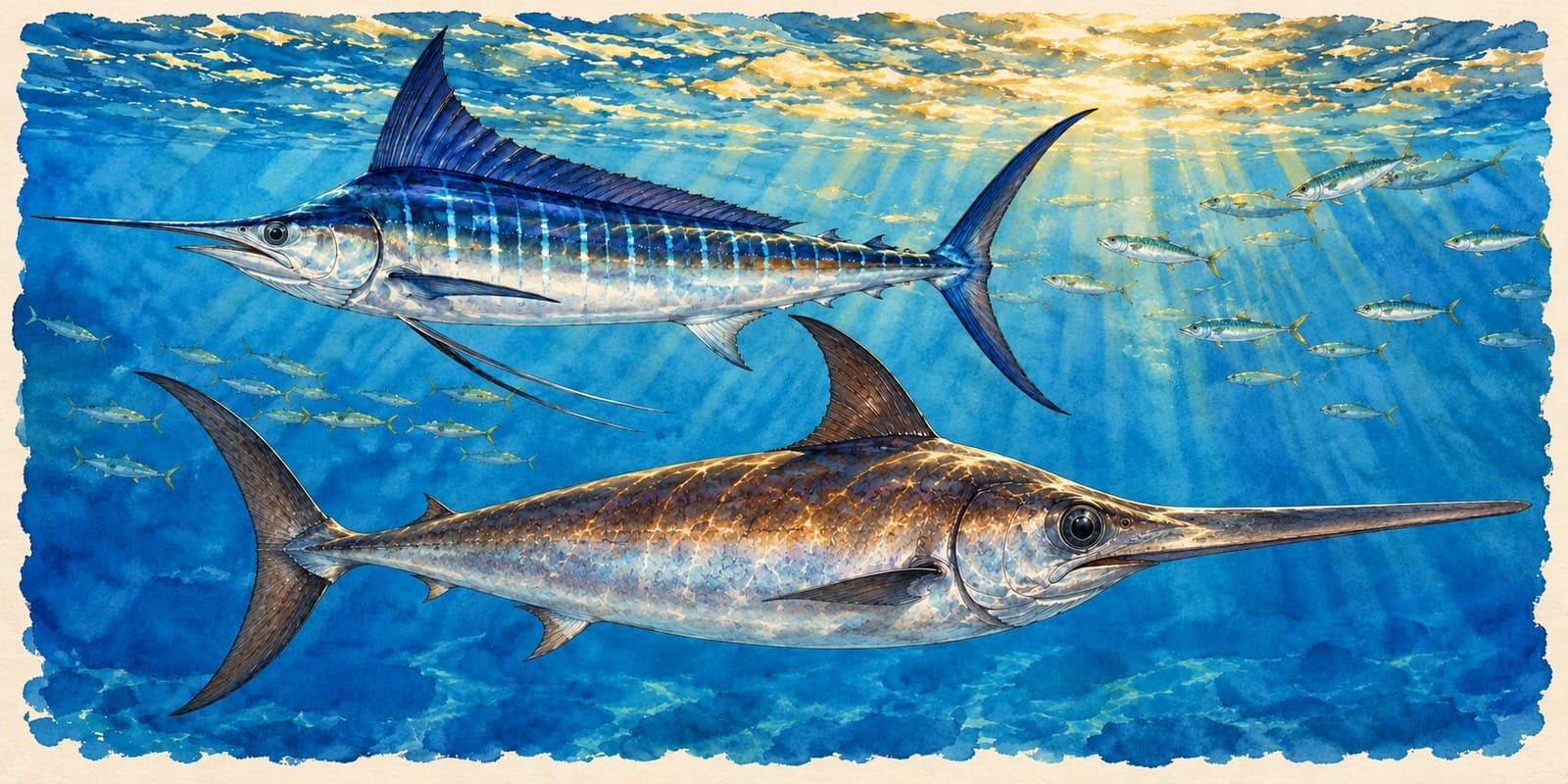
For most of the last century, a Southern California angler who wanted a swordfish had one plan: run the offshore water on a flat day, look for a fish basking on the surface, and try to put a bait in front of it. Club records show how rarely that worked. Then, around 2019, local anglers started fishing for swordfish where swordfish actually spend the day, a thousand feet down, and the catch changed almost overnight.
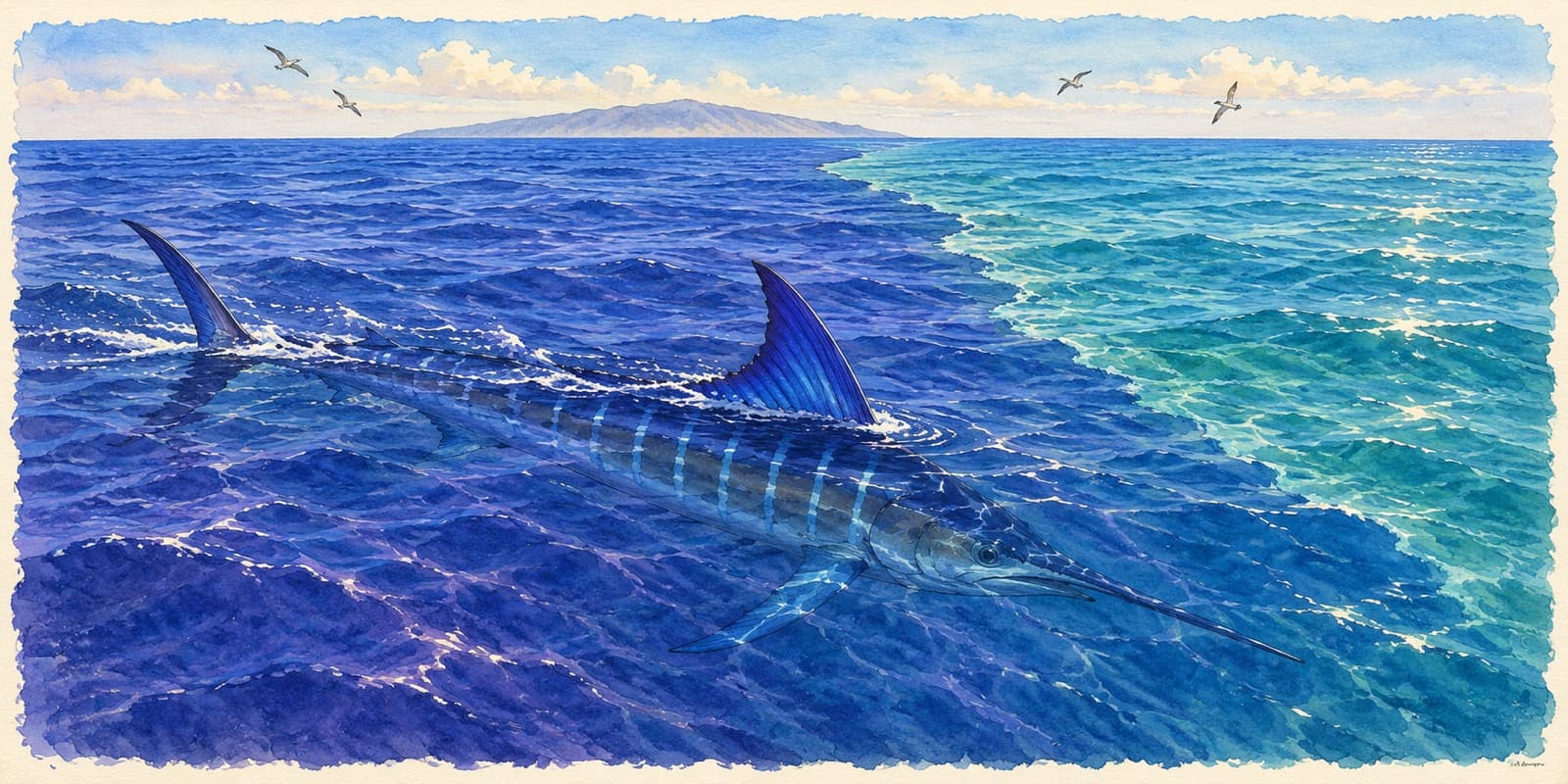
This post is about that method, deep-dropping, in plain language: where it is done, how the rig is built, and how the day goes. If you want to know the fish first, the swordfish species guide covers who the broadbill is and why it lives so deep. And if the fish you saw was up on the surface and you are not sure it was a broadbill at all, telling a swordfish from a striped marlin walks through the differences.
Why deep, and why in daylight
Swordfish feed near the surface at night and drop deep by day. NOAA Fisheries and the Pfleger Institute of Environmental Research tracked swordfish off Southern California and found they spend most of the day deeper than 700 feet (NOAA Fisheries). East Coast anglers and commercial fishermen had already learned to fish for them there. When Southern California anglers borrowed the idea, the results were dramatic.
A 2022 paper in California Fish and Wildlife documented the change (Aalbers et al.). The state's recreational swordfish catch went from none in 2017 and fewer than three in 2018 to 126 in 2019. The Balboa Angling Club, whose members had averaged one or two swordfish a year since 1979, weighed 27 in 2019.
Where it is done
The method needs deep water close to steep bottom: the walls of submarine canyons, the edge of the continental shelf, and the flanks of seamounts and ridges. Southern California has a lot of that close to shore. Hueneme, Dume, Redondo, Newport, Carlsbad and La Jolla canyons all sit within a few miles of the beach, which puts deep-drop water within reach of a well-prepared small boat on a calm day. The banks around the Channel Islands are fished too.
The 2022 study found most of the boats launching from private marinas between San Diego and Santa Barbara, especially San Diego Bay, Mission Bay, Dana Point Harbor and Newport Bay. Out of Point Loma, Dana Point and Newport, the canyons are a short run.
When
The local season runs from late summer into early winter. The species guide puts the best months at August through November. Angling club catches in the 2022 study ran from July through December and peaked in September, and charter catches in 2019 were strongest in November and December.
The rig, from the top down
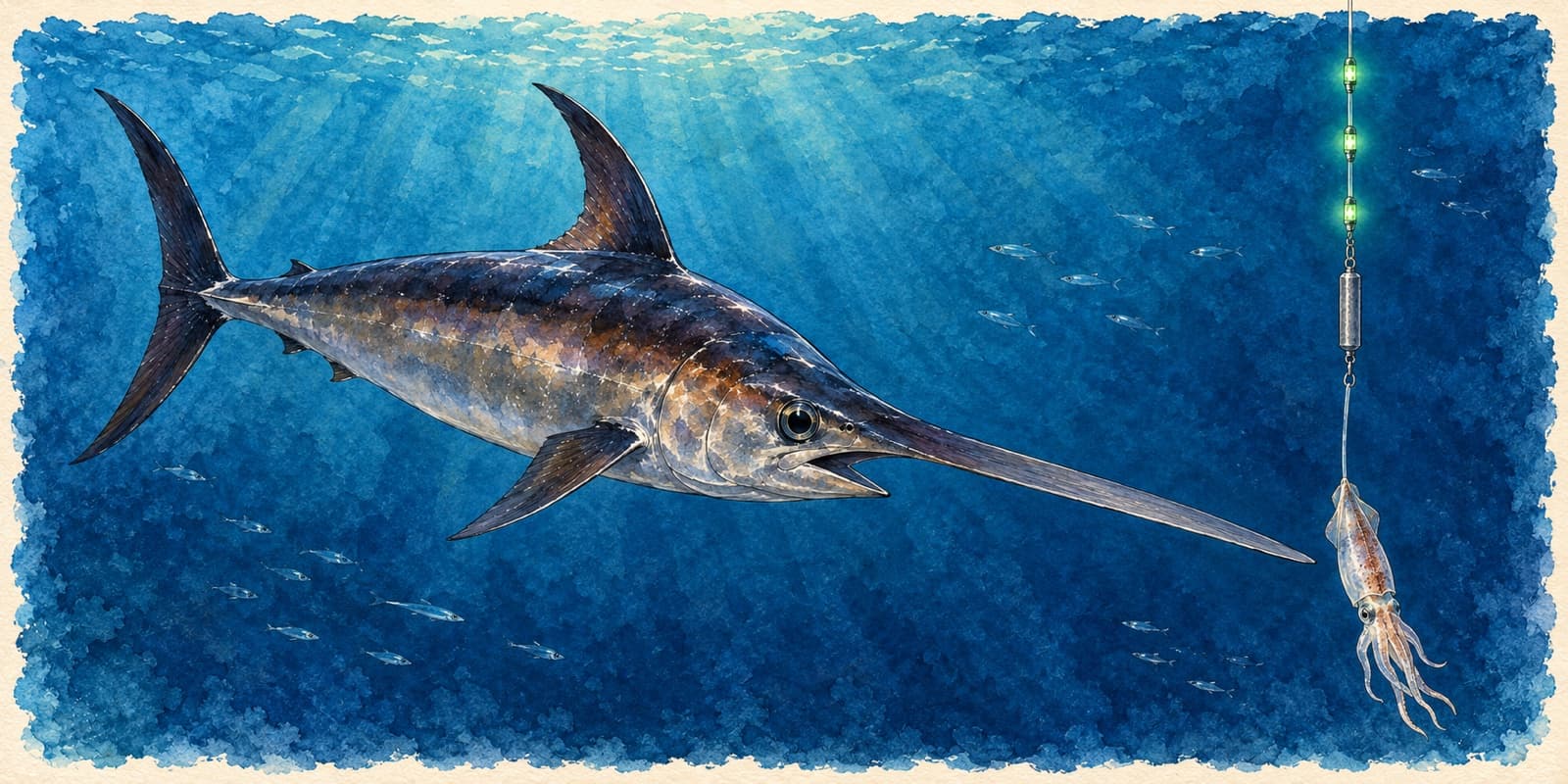
A deep-drop rig is built to do three things: get a bait to the right depth fast, keep it there while the boat drifts, and let you feel a bite through more than a thousand feet of line.
- Main line: braid. Braid of 80 pounds and up is standard. It is thin, so the current pushes it around less, and it barely stretches, so a bite telegraphs all the way up.
- Top shot: heavy monofilament. A long top shot of heavy mono, often 75 to 150 feet of 200-pound, joined to the braid. It adds a little stretch and abrasion resistance at the business end.
- Lights. Swordfish hunt in near darkness, and lights near the bait draw in squid and small fish. Anglers fasten small battery LED strobes or chemical light sticks along the leader and near the sinker. Nobody agrees on the best color or count, so carry a few kinds.
- Sinker. Several pounds of lead, clipped on above the leader. Published setups run from about 4 to 12 pounds depending on depth and drift. Some anglers rig the weight to break away once the bait reaches depth, so they are not fighting the lead along with the fish. Others keep it fixed.
- Leader. A long leader of very heavy monofilament or fluorocarbon. An adult swordfish has no teeth, but its bill and a long fight are hard on light line.
- Hook and bait. A whole large squid, 12 to 15 inches long, on a big J-hook or circle hook. Squid stays on the hook through attention from small fish better than mackerel, bonito or belly strips. Tackle shops sell pre-rigged swordfish squid, frozen and ready to drop.
Rod, reel and the electric question
The outfit is heavy and short. A stout bent-butt or short curved-butt rod rated for 80- to 130-pound line keeps the leverage on your side.
On the reel, you have two choices. Electric reels bring a heavy rig back up from a thousand feet without wearing you out, and most show how much line is out. A large two-speed lever-drag reel, cranked by hand or with a drill-powered handle attachment, does the same job slower. Some tournaments ban electric assist, so check the rules of any event you fish.
How the drift works
- Read the depth before you drop. Most anglers start in water 1,400 to 2,000 feet deep along a canyon edge, with the bait set somewhere in the zone where the fish feed. The 2022 study found anglers' preferred fishing depths to be roughly 650 to 1,200 feet, and some crews set baits as shallow as 800 to 1,100 feet.
- Drop slowly with the boat idling ahead. That keeps the leader from tangling around the main line on the way down.
- Keep the line close to vertical. A line scoping out behind the boat puts the bait at the wrong depth and hides the bite. That is why calm days and light breeze matter so much, and why the drift is everything.
- Fish more than one depth. Many boats fish one line straight down and another drifted away from the boat on an inline float at a different depth.
- Watch the rod tip. A twitch means a fish is looking at the bait. A rod that suddenly springs upward means a fish has taken the bait.
The fight
A hooked swordfish often heads for the surface first, sometimes jumping, then turns and dives hard. Steady pressure wins. Expect a long fight. The species guide's warning, a full day for one bite and an hour of work on it, is a fair description of a good day. Agree in advance who leaders the fish, who gaffs it, and whether it is coming aboard at all.
Size matters to that last decision. Angling club fish weighed in 2019 averaged about 180 pounds, and the authors of the 2022 study set that against an estimated size at which most females have matured of about 216 pounds. Many of the swordfish caught here are below that size.
Rules and release
Swordfish are a highly migratory species under federal and state management, and the rules for gear, reporting and how many you may keep change. Commercial deep-set buoy gear now fishes much of the same water in federal waters beyond three miles. Read the NOAA Fisheries West Coast highly migratory species page and the CDFW ocean sport fishing regulations before every season.
If you release one, keep it in the water and cut the leader close to the hook.
What else lives down there
Deep-drop gear reaches water most anglers never fish. Bigeye threshers turn up on swordfish gear, and the same deep, cold water is home to one of the strangest fish on this coast. Our post on opah in Southern California covers the warm-blooded moonfish.
Where Fish or Pass fits
The swordfish guide is a profile. Fish or Pass does not grade swordfish. The Bite Score grades offshore fish such as bluefin and striped marlin from surface conditions and recent reports, and a swordfish a thousand feet down lives in water no surface reading describes. What the NOAA marine forecast can tell you is whether the day is calm enough to keep a line vertical. The score cannot make a fish bite.