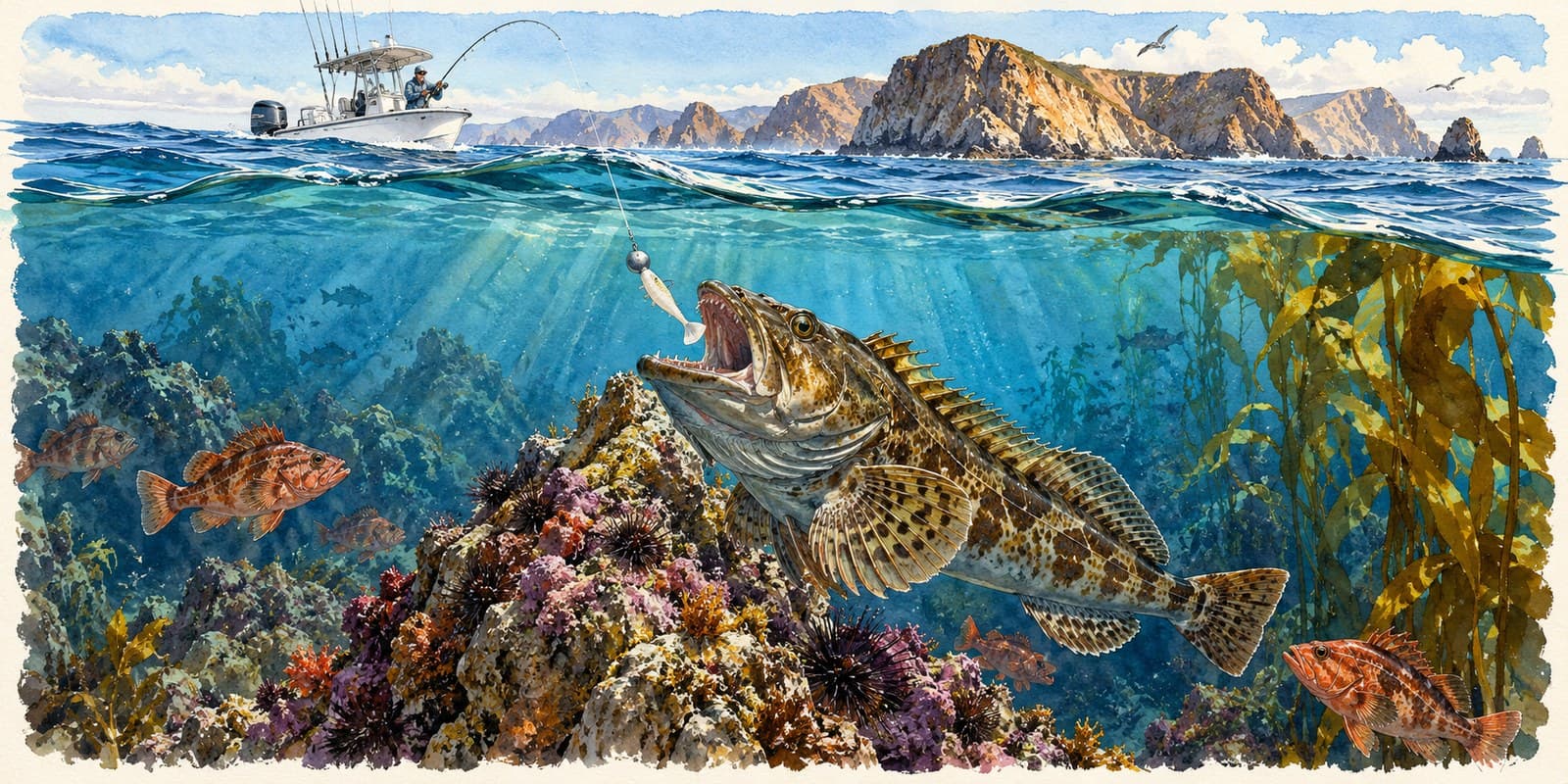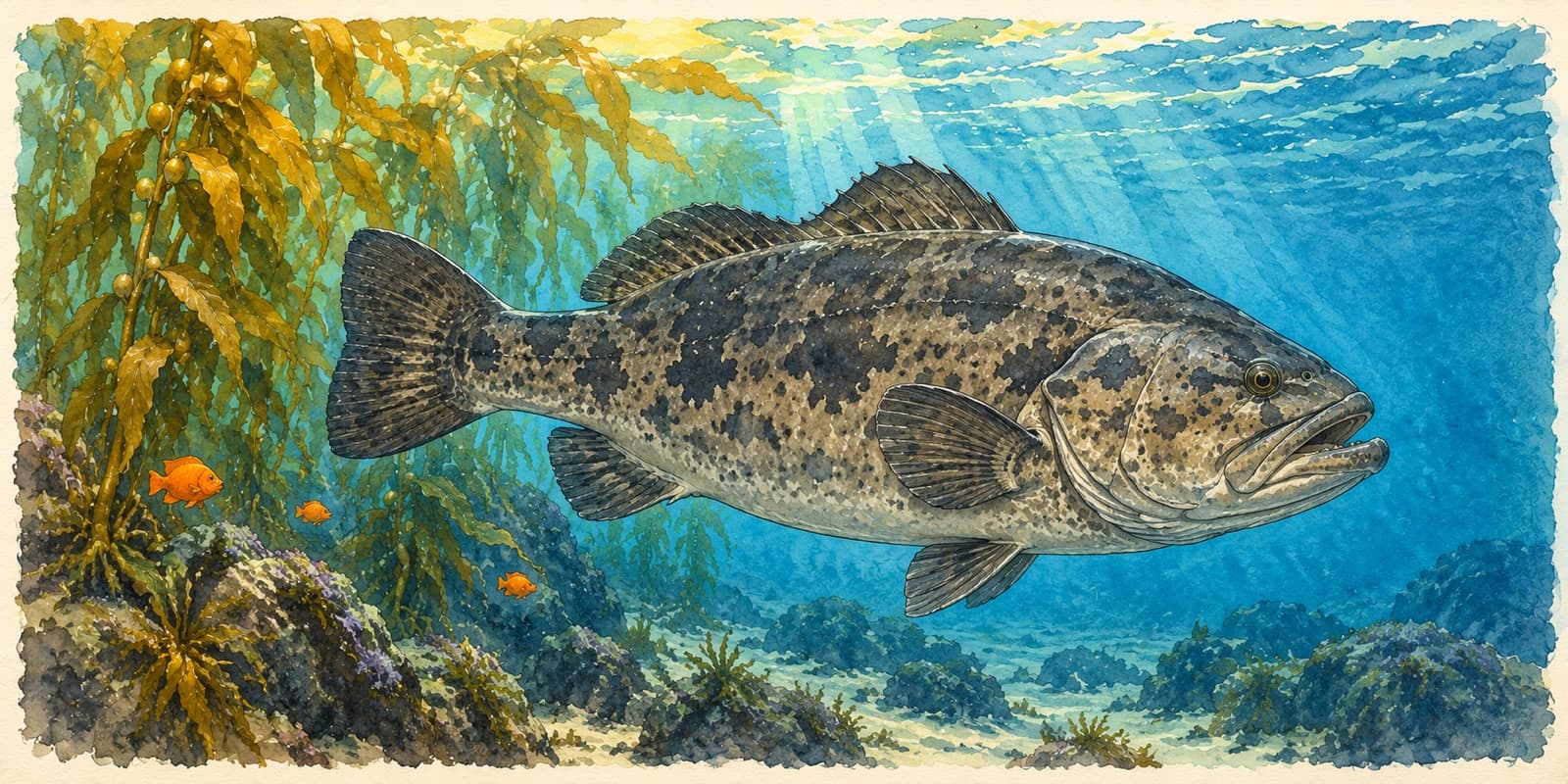
For decades, divers in the Catalina kelp simply did not see giant sea bass. Surveys off the island went 29 years without recording one. Today they hang along the kelp edge at Catalina and Anacapa in summer, big enough to stop a diver mid-kick, and they eat baits meant for other fish often enough that every Southern California angler should know what to do when one does.
This is how the biggest fish in the kelp forest was fished down, how California stepped in, and what the comeback actually looks like. For the fish itself, start with our giant sea bass guide.
A fish built to be overfished
Giant sea bass are not bass. They are wreckfish, and for most of the twentieth century Californians called them black sea bass. Nearly everything about how they live made them easy to wipe out.
- They grow slowly. CDFW's estimates put a fish at about 30 pounds at six years, 100 pounds at ten and 150 pounds at fifteen.
- They mature late. Males have been found mature at about 40 pounds and females at 50 to 60, somewhere around 11 to 13 years old.
- They gather to spawn. Gonad studies point to a summer spawn, July through September, and the fish appear to return to the same places at the same time each year.
- They stay home. Adults hold on the edges of shallow rocky reefs, about 35 to 130 feet deep, often under kelp, and stay put even when the kelp is gone.
A fish that takes a decade to breed, shows up at the same reef every summer and will not leave it is a fish a fleet can find and empty. That is what happened. Most of these details come from the CDFW status report on giant sea bass published in 2001.
The commercial peak: 1932
Commercial landings from U.S. waters peaked in 1932, near 200,000 pounds, and declined from there. Fish from Mexican waters, landed in California ports, peaked the same year at over 800,000 pounds and did not drop below 200,000 for good until 1964. A few hook-and-line fishermen targeted giant sea bass. Many more came up in gillnets set for halibut and white seabass.
By 1980, according to a 2024 CDFW study of the gillnet fishery, California landings had fallen below 40,000 pounds.
The sport peak: 1963
Recreational landings followed the same arc a few decades later. The party boat catch from California waters peaked in 1963, and the catch from Mexican waters peaked in 1973. CDFW notes that the later peak reflects when the sport fishery grew, not a healthier population.
A few boats ran summer trips to spawning aggregations far down the Baja coast that produced 70 to 100 fish a trip, and one trip took 255 in three days. In CDFW's words, once those aggregations were fished, "the fishery disappeared with the fish." Spearfishers were still taking them as trophies into the 1970s, when numbers were already well down.
The big fish of that era still set the mark. The world record, 563.5 pounds, came from Anacapa Island in 1968.
1981: California stops the take
In 1981 California passed a law that prohibited the take of giant sea bass for any purpose. Some sources, including the National Park Service, date the ban to 1982; CDFW dates it to 1981. The law left one opening: commercial gillnet and trammel net boats could keep and sell two fish a trip caught incidentally. In 1988 that was cut to one.
The ban on its own did less than it sounds. It stopped the selling, but not the netting over the reefs where the fish lived, and fish tangled in nets were still dying and going back over the side. The bigger change came in 1994, when voters passed Proposition 132 and banned gillnets in state waters. That pushed the nets out of most of the water giant sea bass use, within three nautical miles of the mainland and one around the islands.
What came back
The recovery is real, slow, and hard to put a number on.
- Catalina. Dive surveys at the island went 29 years without a giant sea bass before one turned up again in 1996.
- Palos Verdes. Scuba surveys off the peninsula recorded none from 1974 to 2001. They reappeared in 2002.
- The northern islands. Acoustic tagging found that many fish leave Anacapa in winter and come back in May or June, according to Channel Islands National Park.
The 2024 CDFW study found "increasing evidence that their populations are slowly recovering," and also that there is still no current population estimate. The 2001 report made a point worth keeping in mind: an angler who hooks several in a day at one of the few spots where they gather can come away thinking the species is thriving, while the fish remain absent from most of the coast.
Researchers now follow individual fish by the spot pattern on their flanks, which is unique to each one. The Spotting Giant Sea Bass project at UC Santa Barbara builds its records from photos taken by divers.
If one eats your bait
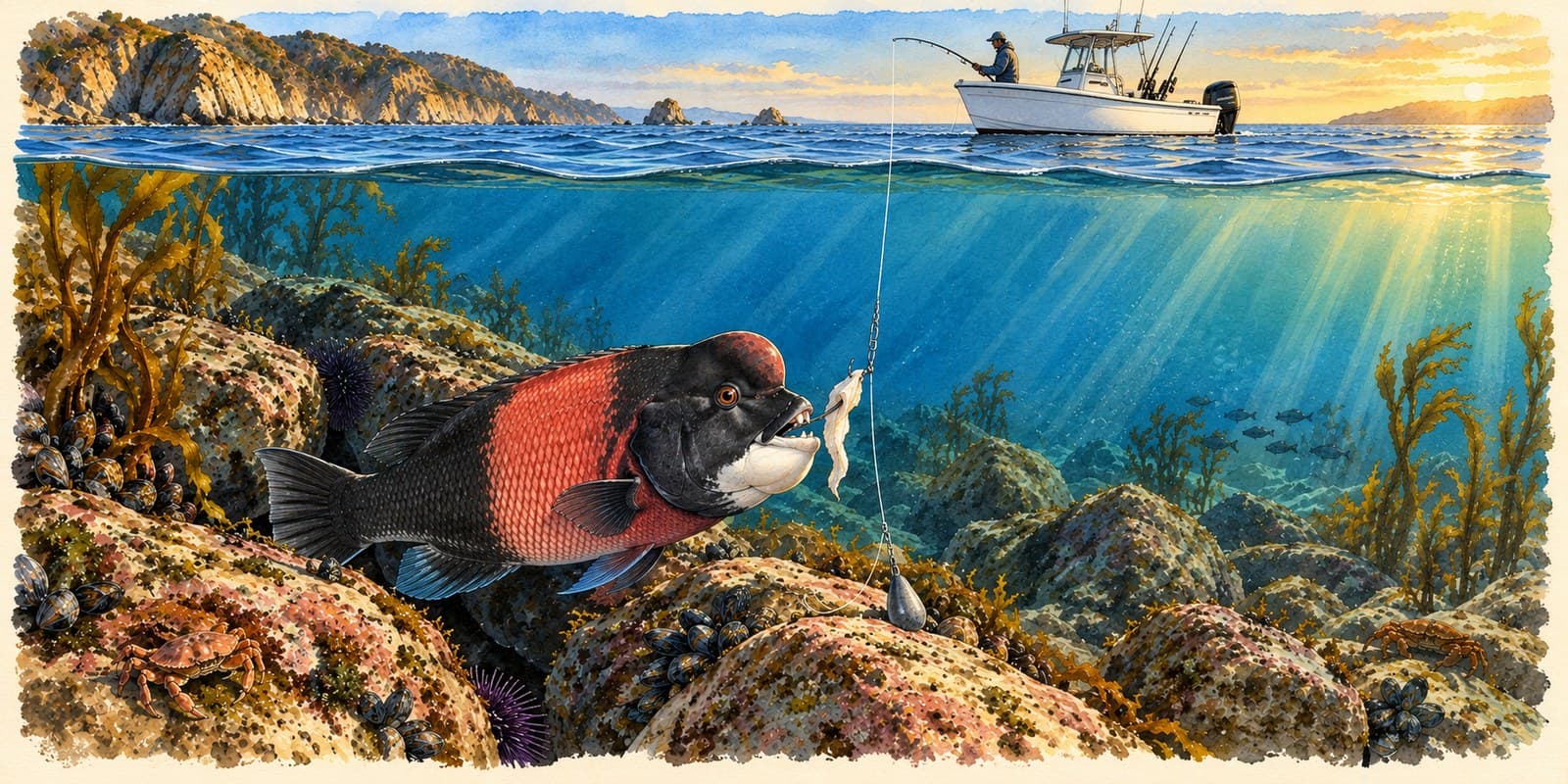
It happens most in summer, on the same reefs and over the same squid as everything else. Adults forage over sand for spawning squid, so anyone soaking squid for white seabass off the islands is fishing where giant sea bass feed. Our post on white seabass and the squid spawn covers that fishery. They also live on the kelp-edge reef that holds California sheephead and calico bass.
Take is prohibited for recreational anglers in California. If you hook one:
- Keep it in the water. Do not lift it over the rail or gaff it for a picture.
- Get the hook out or cut the leader close. Do it quickly, alongside the boat.
- Take a photo in the water if you can. A clear shot of the flank is the kind of picture the spot-pattern researchers work from.
Check the current CDFW ocean sport fishing regulations for the exact rule. They change, and they are the authority here.
Where Fish or Pass fits
Giant sea bass are not a fish to target, and Fish or Pass does not grade them. The species guide is a profile of the fish. The Bite Score reads conditions for graded species like calico bass, and the kelp that holds a good calico day around the Channel Islands is the same kelp where giants turn up. The score cannot tell you whether one is home.