Most big-game fish off Southern California mean a long run offshore. The thresher does not. Through spring and summer, common threshers hunt bait schools off the beaches and along the kelp line, in water a half-day boat or a skiff can reach. They fight like an offshore fish, they jump, and they do something no other shark here does: they hunt with their tail.
That tail is the whole story. It is how they feed, it is why so many end up hooked in the wrong place, and it is why how you fish for them decides whether a released thresher lives. This post covers where they hold, what they eat, and how to hook one in the mouth instead of the tail.
A shark that hunts with its tail
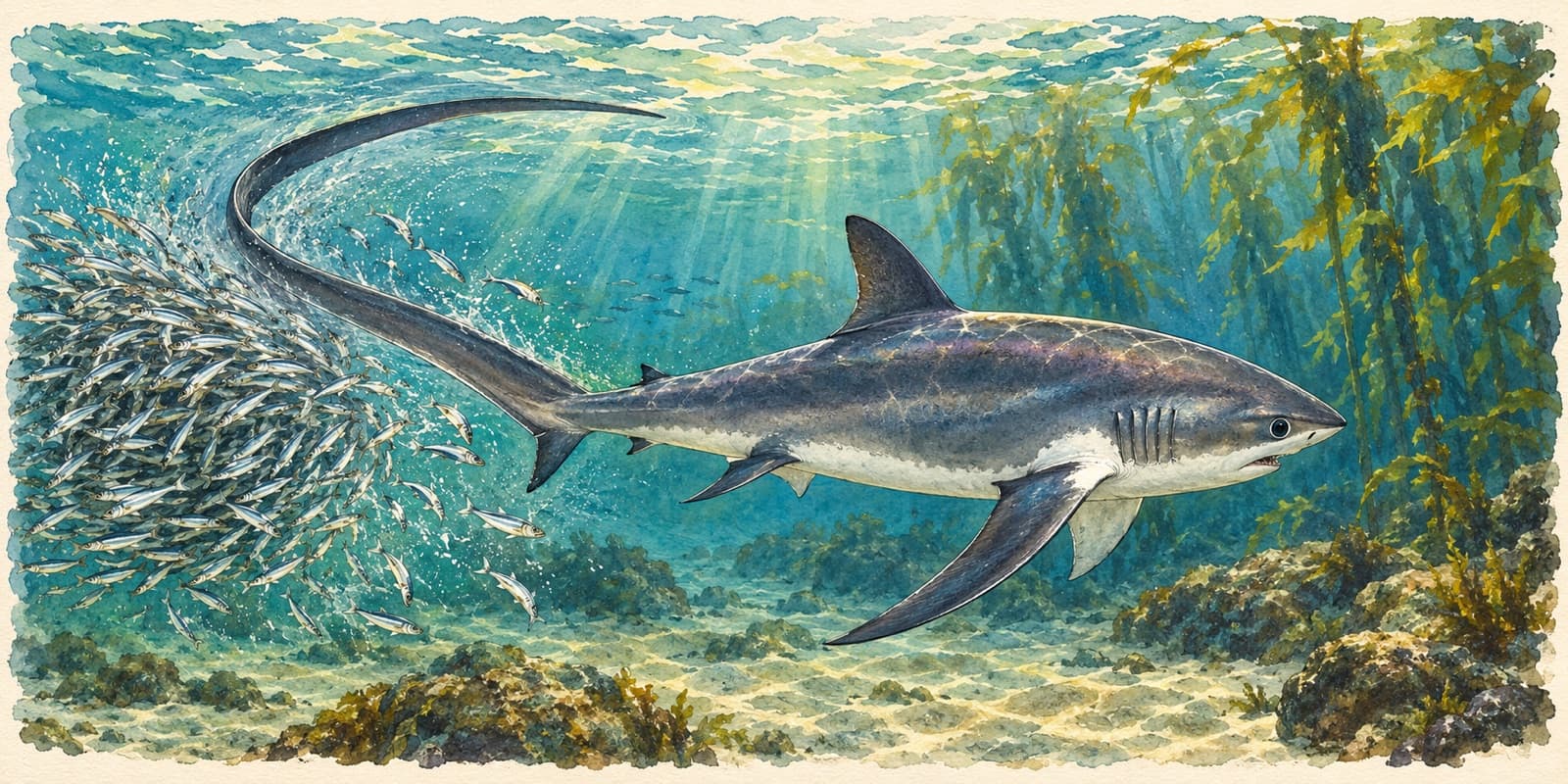
The upper lobe of a thresher's tail is about as long as the rest of the shark. Researchers at the Pfleger Institute of Environmental Research filmed 33 thresher feeding attempts on bait. Every recorded feeding event began with the upper lobe of the tail, and 42 percent included an active strike with it (PIER). The sharks used it two ways: a forward whip that sends a wave up the body to the tail tip, and a sideways swat while swimming alongside the bait. The point is to stun or immobilize the prey before eating it.
You can sometimes see this from the boat. On a calm morning, a thresher working a bait school shows as tail tips slashing the surface, fish jumping clear, and terns hovering low over the commotion.
Where and when they show
Threshers are a nearshore fish here. They work from the edge of the surf out to about a mile off the beach, often in water around 50 feet deep, over the rock piles, reefs and ledges that hold bait. NOAA Fisheries describes the species as commonly found close to shore in plankton-rich water, moving seasonally between Southern California and Baja and the Pacific Northwest as temperatures change, and notes that young threshers use nearshore waters (NOAA Fisheries).
The season follows the bait. Writers who fish them describe the nearshore bite coming alive around mid-May as baitfish move up the coast, with action from spring into early fall. The thresher species guide puts their preferred water at about 58 to 68°F, cooler than the yellowfin and dorado want.
Off-color water is not a reason to leave. Threshers do not seem to mind green water and may even prefer it, because nutrient-rich water is what holds the anchovies. Santa Monica Bay and the beaches off Orange County, an easy run from Newport, are well-known thresher water. How close in? In May 2012 a private boat trolling for threshers about two miles off Newport Beach, in roughly 100 feet of water, hooked a fish. It turned out to be a 140-pound opah, which is its own story: see opah in Southern California.
What they eat
Threshers are picky compared with the other sharks offshore. A study of shark stomachs from the California Current, published in 2012, found that northern anchovy and Pacific sardine were the most important prey of common threshers, and called them the most specialized feeders of the three sharks it looked at. NOAA lists anchovies, sardines, hake, mackerel and squid.
Fishing for threshers is fishing for anchovies. Find dense bait on the meter near the beach, or terns working a school on the surface, and you are in the right place. A shark shadowing the bait on the sonar is better still.
Why so many are tail-hooked
A shark that hits with its tail first often hits the hook with its tail too. For years the standard way to fish for big threshers was to troll lures or large J-hooks, and a shark that swatted at the lure came up foul-hooked in the tail and was dragged to the boat backwards.
That matters for release. A shark towed tail-first cannot swim forward or push water over its gills. In a California study that put satellite tags on tail-hooked threshers caught on stand-up tackle, 26 percent died after release. Every one of the deaths was a large shark, about six feet or more to the fork of the tail, that had been on the line for 85 minutes or longer. In later work, all seven mouth-hooked threshers that were tagged survived the first ten days or so after capture.
The lesson is not that every thresher fight ends badly. It is that a tail-hooked shark on a long fight is the worst case, and the fishing method largely decides which one you get.
How to hook one in the mouth
- Fish live bait, not lures. Drift or slow-troll a live sardine or small Pacific mackerel. A thresher that wants to eat a bait has to take it in its mouth.
- Use circle hooks. A circle hook in the corner of the jaw is easier to release and less likely to foul-hook a shark than a J-hook, and treble hooks are worse still. CDFW outreach on threshers recommends circle hooks for exactly this reason.
- Spread your baits through the water column. One common approach is three lines at different depths: one with a small egg sinker, one with a lighter sinker, one unweighted.
- Use fluorocarbon, not wire. Nearshore thresher setups run a long, heavy fluorocarbon leader. A thresher's teeth are small, so wire is not needed. Shark gear rules can change, so check the current CDFW regulations before you rig.
- Skip snag-and-drag. Trolling deep-diving plugs through a bait school is the method most likely to put a hook in a tail.
Releasing a thresher
Many of the threshers caught nearshore are young fish that have not yet bred. Writers who fish them point out that even a 150-pound thresher can be immature.
- Keep the fight short. The tagging work points to long fights on big fish as the danger.
- Keep the shark in the water. Cut the leader as close to the hook as you safely can.
- Never drag it backwards. A tail-hooked shark towed tail-first cannot breathe. Bring it alongside, cut it loose and let it swim off forward.
Not every thresher is a common thresher
Three threshers live off California. Common and bigeye threshers are the most prevalent here, and pelagic threshers turn up in some years. The common thresher is the one along the beaches. Its white belly extends up over the base of the pectoral fins. A bigeye has a huge, upward-looking eye and grooves on top of its head, and lives deeper. It is the thresher that turns up as bycatch on deep swordfish gear. A pelagic thresher has dark skin, not white, over the base of its pectoral fins.
Rules, and how the stock got here
Common threshers were fished hard by the California drift gillnet fleet, and landings fell sharply after a peak in the early 1980s. The stock has recovered: NOAA's 2018 assessment found the Pacific common thresher is not overfished and not subject to overfishing. It is managed as a highly migratory species, with federal and state rules that change. Read the NOAA Fisheries West Coast highly migratory species page and the CDFW ocean sport fishing regulations before you go.
Threshers are the inshore half of the Southern California shark picture. For the offshore half, read mako sharks in Southern California.
Where Fish or Pass fits
The thresher guide is a profile. Fish or Pass does not grade threshers. The Bite Score grades nearshore fish such as calico bass and yellowtail, and a day with bait on the beach and clean conditions helps everything that eats anchovies. It cannot find the shark under the terns, and it cannot make one bite.